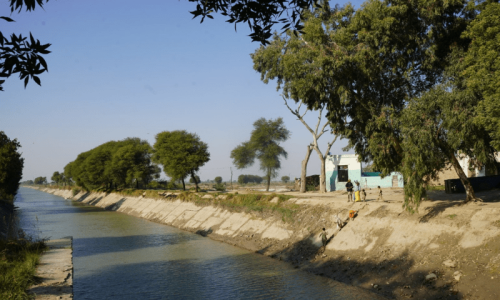
THERE seems to be little the PPP can do apart from repeatedly threatening that it will withdraw its support for the ruling coalition if plans to build new canals on the Indus are not dropped.
The backlash has been severe in Sindh, and the PPP appears to have realised that it must distance itself from the canal projects if it wishes to keep public sentiment in its favour. The party has suffered a hit to its political capital because it is perceived as being tightly tethered to the current regime.
Not only that, there are also lingering doubts about the PPP’s claim that it was blindsided on the matter. Even though the party has repeatedly refuted claims by PML-N leaders that President Asif Zardari himself greenlit the canals, and has also sought the Council of Common Interests’ intervention in the matter, the general sentiment in Sindh has soured because of the perceived threat to the province’s lifeline.
Had drought-like conditions in Sindh not made the Indus water levels a matter of life or death for its inhabitants, the issue may have been swept under the rug. Canal protests led by nationalists, farmers and civil society leaders were largely ignored before the Sindh government formally entered the conversation. The Green Pakistan Initiative, under which these canals are to be made, is, after all, a project of ‘national interest’.
It appears that the PPP could not, at least initially, openly oppose the canals given the stakes involved. However, once it became clear that public anger was only building up, the party realised it needed to fight the case. If it is serious, it will need more than threats to make its voice heard. Punjab has made it clear it has little interest in Sindh’s problems. Indeed, several recent steps it has taken, such as opening the Taunsa-Panjnad link canal, have been seen as a direct provocation by the lower riparian.
It is obvious that the interests of the people of Sindh were not factored in when decisions regarding the canal projects were being made at the high table. Even the party representing the province arguably neglected its duty in this regard. The consequences of the state taking decisions without regard for its people can be seen yet again in the form of widespread restlessness and anger.
The country can ill-afford a dispute of this nature at this juncture. With KP and Balochistan already reeling from unrest and violent upheaval, a Sindh-Punjab water dispute will greatly complicate the task of attaining social stability. The CCI must be convened at the earliest, and public representatives should be given a fair chance to voice their constituents’ concerns. The state should be putting out fires, not lighting new ones.
Published in Dawn, April 20th, 2025