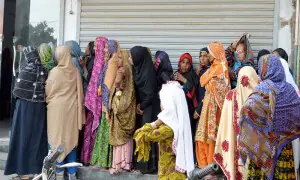
KHAN YUNIS: With food scarce in the besieged and conflict-stricken Gaza Strip, some desperate families have turned to eating sea turtles as a rare source of protein.
Once the shell has been removed, the meat is cut up, boiled and cooked in a mix of onion, pepper, tomato and spices. “The children were afraid of the turtle, and we told them it tasted as delicious as veal,” said Majida Qanan, keeping an eye on the chunks of red meat simmering in a pot over a wood fire.
“Some of them ate it, but others refused.” For lack of a better alternative, this is the third time 61-year-old Qanan has prepared a turtle-based meal for her family who were displaced and now live in a tent in Khan Yunis, southern Gaza largest city.
After 18 months of devastating conflict and an Israeli blockade on aid since March 2, the United Nations has warned of a dire humanitarian situation for the 2.4 million inhabitants of the Palestinian territory.
The heads of 12 major aid organisations warned on Thursday that “famine is not just a risk, but likely rapidly unfolding in almost all parts” of the territory. “There are no open crossings and there is nothing in the market,” said Qanan. “When I buy two small bags (of vegetables) for 80 shekels ($22), there is no meat,” she added.
Sea turtles are internationally protected as an endangered species, but those caught in Gaza fishermen’s nets are used for food. Qanan mixes the meat with flour and vinegar to wash it, before rinsing and boiling it in an old metal pot.
“We never expected to eat a turtle,” fisherman Abdel Halim Qanan said. “When the war started, there was a food shortage. There is no food. So (turtle meat) is an alternative for other sources of protein. There is no meat, poultry or vegetables.” The UN’s Office for the Coordination of Humanitarian Affairs has warned that Gaza is facing its most severe humanitarian crisis since the conflict began on Oct 7, 2023.
Fighting has raged in Gaza since then, pausing only twice — recently during a two-month ceasefire between Jan 19 and March 17, and in a previous one-week halt in late Nov 2023. The World Health Organisation’s regional chief Hanan Balkhy said in June that some Gazans were so desperate that they were eating animal food, grass, and drinking sewage water.
Hamas on Thursday accused Israel of using “starvation as a weapon” against Gazans by blocking aid supplies. Fisherman Qanan said the turtles were killed in the “halal” method, in accordance with Islamic rites. “If there was no famine, we would not eat it and leave it, but we want to compensate for the lack of protein,” he said.
Published in Dawn, April 20th, 2025