Revised deal with four govt power plants to save around Rs1.6tr


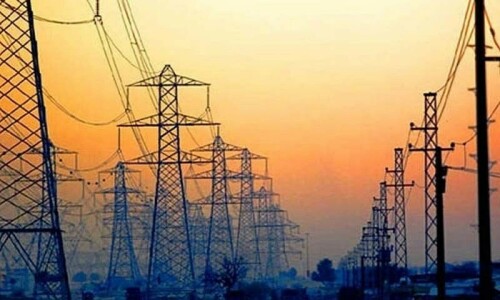
ISLAMABAD: The government has formally asked the National Electric Power Regulatory Authority (Nepra) to allow a reduction in power purchase rates from four public sector power plants, entailing about Rs1.58 trillion savings over their remaining life spans under revised agreements.
The request involves a change in terms of contracts from ‘take or pay’ to a ‘hybrid take and pay’ model, a reduction in the rate of return and a cap on dollar indexation at Rs168.
Nepra has scheduled a public hearing on April 24 to deliberate on the proposal submitted jointly by the four government-owned power plants (GPPs) and the Central Power Purchasing Agency (CPPA), a power division entity.
These four power plants, with a cumulative capacity of about 3,700 MW, include two LNG-based projects at Balloki and Haveli Bahadur Shah of around 1,220 MW each (with a combined reported savings of about Rs1.1tr), and the 747 MW Guddu Power Plant and the 510 MW Nandipur Power Project (combined savings of Rs355bn). All four are owned by the federal government.
Rs3.5tr savings expected overall as govt seeks to amend agreements of 29 electricity producers
The total savings on account of the four projects come to about Rs1.6tr in terms of capacity charges, operation and maintenance costs, etc.
Formalities for adding two similar LNG projects of the Punjab government at Bhikki and Trimmu were being completed, which would add savings from the public sector so far to Rs2.16tr, an official said.
In their joint applications, the CPPA and GPPs have reported that negotiated settlement agreements (NSAs) were signed on April 8, following the federal cabinet’s formal agreement on March 19 to reduce consumer-end tariffs and alleviate the burden on the general public through a ‘hybrid take and pay’ model.
The applicants requested that Nepra waive the applicable tariff fees, citing national interest and consumer benefit. Under the NSA, key tariff components will be restructured, including the indexation of operations and maintenance (O&M).
The revised O&M costs will be indexed quarterly. Local and variable components will be adjusted at the lower of five per cent per annum or the actual average national Consumer Price Index (CPI) for the preceding 12 months.
For the fixed foreign and variable components, the current indexation mechanism will continue; however, rupee depreciation against the US dollar will be factored in only up to 70pc of the actual annual depreciation. In contrast, any appreciation in the rupee’s value will be fully passed on to consumers.
The return on equity (ROE) component shall be redetermined to a 13pc rate of return at the fixed exchange rate of Rs168 per dollar based on Nepra-determined quarterly indexation for the October-December 2024 period as a revised reference. Thereafter, there shall be no exchange rate indexation.
From the effective implementation date, the capacity purchase price (CPP) insurance component will be treated as a pass-through item, capped at 0.8pc of the sum insured under the power purchase agreements.
Under the NSA, the applicants agreed to implement a ‘hybrid take-and-pay model’, whereby tariff payment to the company shall be made by the CPPA as follows: from the effective date, prorated for remaining period of the current agreement year, and thereafter for every agreement year, the company will be entitled to 35pc of revised RoE components of tariff as part of the CPP.
From the effective date, in case the despatched and delivered net electrical output (NEO) of the company exceeds 35pc of the total contract capacity in terms of kilowatt-hours (kWh), then the company will be entitled to receive RoE components of tariff, which shall be calculated on the actual NEO exceeding 35pc of the total contract capacity in terms of kWh and the company shall claim the differential CPP accordingly.
These revisions are part of restructuring power purchase agreements (PPAs) involving 29 independent power producers (IPPs) and government-owned plants.
According to the Power Division, these renegotiated terms are expected to generate total savings of Rs3.5tr over contract periods ranging from three to 20 years, depending on each project’s commercial operation date.
Published in Dawn, April 19th, 2025