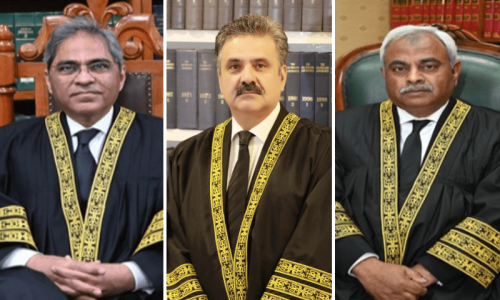
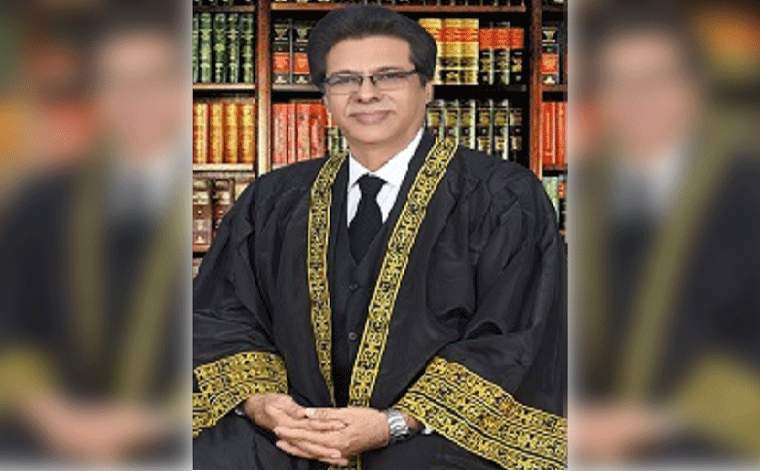
ISLAMABAD: Justice Syed Hassan Azhar Rizvi, a member of the Supreme Court’s constitutional bench, on Friday questioned what he called a ‘pick-and-choose’ approach in prosecuting civilians after the May 9, 2023, acts of violence and arson.
“How individuals were selected for military trials while some were picked for the trials by civilian courts,” Justice Rizvi wondered.
The observation came against the backdrop when 5,000 individuals were rounded up for their involvement in the May 9 violence, but only 105 were tried by military courts and the rest by anti-terrorism courts.
Justice Rizvi was a member of a seven-judge constitutional bench that had taken up a set of 38 intra-court appeals against the October 2023 judgement. Justice Aminuddin Khan headed the bench.
Senior counsel Khawaja Haris Ahmed, who was representing the defence ministry, responded that trials by military courts were not done on the basis of arbitrary selection rather cases were referred to different such forums depending on the nature and severity of the offence.
On Friday, the counsel closed his arguments after which the bench postponed further proceedings.
Attorney General for Pakistan (AGP) Mansoor Usman Awan will later apprise the court about the point the bench had raised earlier about providing right to appeal to the convicts sentenced by military courts for involvement in the May 9 violence.
During the hearing, Justice Musarrat Hilali observed that the military laws primarily exist to maintain discipline within the armed forces. “But if a civilian attacks military installations, does that automatically bring them under military jurisdiction,” the judges questioned.
Justice Hilali reminded that Section 2(1)(d)(i) and (ii) were added to the Pakistan Army Act (PAA) under the 1962 Constitution that appeared to be in conflict to different provisions of the 1973 Constitution.
Justice Naeem Akhtar Afghan also reminded that the Constitution had never explicitly extended military court powers over civilians. He said many provisions were added to the 1973 Constitution whereas many other articles remained the same which were brought forward from the 1962 Constitution, but despite many amendments provisions regarding the army act had not been touched.
Justice Rizvi said 12 or 13 military installations were attacked during the violence which was a security and intelligence lapse. Whether any concerned military officers were ever held accountable for these failures, he wondered.
Additional Attorney General Chaudhry Aamir Rehman told the court the AGP would address the concern at the next hearing.
Justice Hilali said military law often conflicts with the Constitution. Mr Ahmed countered that court-martial proceedings ensure fair trials and army officers had the capacity and experience.
Published in Dawn, April 19th, 2025