SOCIETY: COOKING UP CHANGE
Suppose you’ve been the victim of a heinous crime and muster the courage to walk into the police station to register a first information report (FIR). But instead of fulfilling their legal duty to register the FIR, the police tell you to leave the premises, accusing you of disturbing the station’s ‘mahaul’ [environment]. Even when you’re a victim, you’re treated like a suspect.
If this sounds outrageous, consider this: You need medical treatment and hospitalisation after an accident and a bystander kindly takes you to the hospital. But the hospital refuses to admit you, arguing that no separate ward is available, or even reserved, for ‘people like you.’ You’re advised to arrange treatment at home or avail yourself of a private facility, none of which are viable options.
These scenarios may sound unbelievable, but they are neither hypothetical nor borrowed from a dystopian novel. Instead, they are based on actual experiences shared by the transgender community of Pakistan.
Pakistan’s transgender community has long existed on the fringes, routinely deprived of their basic rights and dignity. A culinary institute in Lahore is doing what it can to change that…
EXISTING IN PARATHESES
In a paradigm where identity is determined by one’s genitalia, transgenders exist as outliers. They live in the uncomfortable space between two rigidly defined categories — afterthoughts in a well-thought-out system.
I recall having a conversation with a friend a few years ago. As it goes, we vented about the claustrophobic frustration of having a life defined for you before you are born. We are born, placed into schools for years, expected to attend college, find a job and marry someone when we’re in a certain age bracket.
Once we’re married, we’re expected to have children and send them to school, and the cycle repeats itself. That is the road most travelled by, and the monotony drains us.
But now that I look back on the conversation and the trajectory itself, I realise what a privilege it is even to have access to education, employment, family. Speaking with the transgender community and observing their everyday lives will quickly help one realise that this system, which drains us, does not even see them.
A 2022 study published by the United States National Library of Medicine, with a sample size of 214 participants from the transgender community of Pakistan, states that 70 percent of transgender people report receiving a poor quality of healthcare. As compared to the rest of the population, they are at a greater risk of emotional and psychological abuse and physical and sexual violence but have lesser access to healthcare.
Only 39 percent of the participants in the study received any form of education in their lives, a statistic that mirrors other findings. Most community members are denied access to a classroom and pushed to the margins before they even get a chance to begin.
Neha Khan, one of the transgenders Eos spoke to in this regard, says “humain tau kabhi college jana naseeb nahi hua” [We were never fortunate enough to step into a college]. There is quiet violence and an unmistakable sense of deprivation in the way their naseeb [fate] works.
A CULINARY EDUCATION
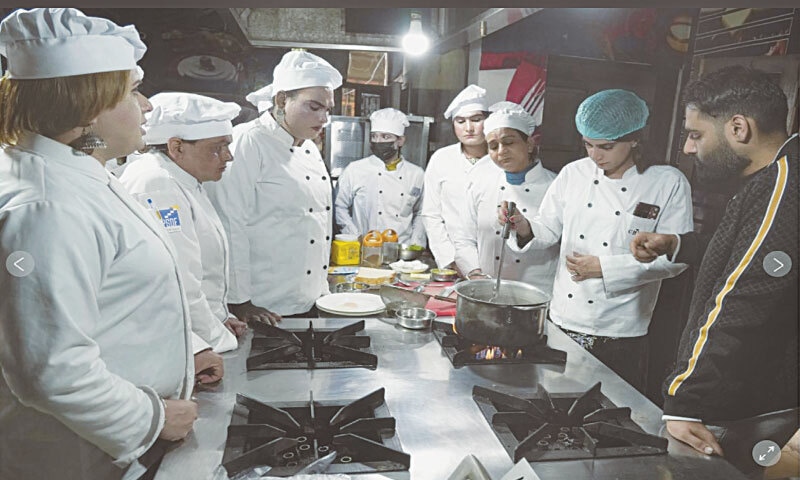
The Culinary & Hotel Institute of Pakistan in Lahore is one of the few institutions trying to change that. Supported by the Punjab Skills Development Fund (PSDF), this institute has recently launched a six-month program for the culinary education of transgenders.
A batch of 50 students is currently enrolled in the class, receiving theoretical and practical instructions from two chefs for the past three months. There is a sense of novelty to all of it — the everyday classes from noon to 4 pm, the Rs 8,000 stipends that students receive monthly and the possibility of an employed future.
Nadia Shahzad, 43, took over the institute in 2018, after the sudden passing of her husband, who set up the institute in 2014. She tells Eos that the enrolment of transgenders wasn’t an easy task. It took her months and frequent home visits to convince Shabnam Chaudhry — the guru or leader of a group of transgenders — of the benefits of the course to her community.
Things are different now. Shabnam and her people show up on time every day, speak highly of the institute as their ‘college’ and learn local and foreign cuisine under the supervision of their chef. They practise what they’ve learnt when they get home and excitedly share pictures with Nadia.
And yet, beneath the excitement, there are unspoken questions: why did it take this long and what is the way forward? While the stipend is a decent initiative, it is not enough to sustain the students’ lives.
Zoya Khan, one of the students, tells Eos that her monthly rent is triple the stipend and it is no coincidence. The community reports unprecedented difficulties in securing a residence; most landlords are not willing to have transgenders as their tenants. If a transgender person somehow secures a rental, they’re often charged twice the amount others would pay.
Driven by “majboori” [necessity], as they term it, even the students enrolled in the course resort to part-time begging or doing dance performance at events. Outsiders unfamiliar with their circumstances often ask, “What is the purpose of teaching you a skill if you’re just going to do the same activities in the evening?” But building skills takes time, and their stipend isn’t enough to survive.
FIXING A BROKEN SYSTEM
The hope that this batch of 50 students carries depends on several contingencies. Zoya and others are concerned that they might not get hired despite learning an employable skill. Even if they do get hired, they’re afraid people will refuse to eat their prepared food.
It is an unfortunate thing to register, but their fears are valid. Once the students receive their certifications, placement in the food industry is the next challenge. The chief executive shared that they are in the process of forming partnerships with restaurants, where the students can work in hot kitchens at the back end. Another idea being floated is managing home-based businesses with companies such as foodpanda.
What these plans do not address is the deeper issue of visibility. Why does the idea of working alongside transgender people make so many uncomfortable? The least we can do is reflect on and challenge our own ingrained biases. Secondly, the change can’t stop at a single classroom.
Beyond the struggle for employment, the transgender community faces immense challenges in accessing healthcare, securing safe housing and simply existing in public spaces without fear.
The culinary school students’ guru shared a bitter reality towards the end of their conversation with Eos: “The same hands that throw lakhs at us to dance and undress won’t even spare a few hundred rupees for us to buy clothing or seek treatment when we are sick,” says Shabnam.
Convincing people that they are good enough to entertain but not good enough to receive fundamental life guarantees is as hypocritical as it gets. We often hear that the system is broken and rigged, but allow me to disagree. A system that turns a blind eye towards this community is not broken; it is working exactly as designed.
And that is precisely what needs to change.
The writer is a final year law student at LUMS.
She can be contacted at 25090056@lums.edu.pk
Published in Dawn, EOS, April 13th, 2025