0
0

The Supreme Court’s (SC) Constitutional Bench on Monday remarked that controlling terrorism was the role of parliament and not the judiciary, during a hearing on intra-court appeals against the apex court’s verdict on the trial of civilians by military courts.
In January, Khawaja Haris, the lawyer for the defence ministry informed the Constitutional Bench that the alleged masterminds and conspirators of the May 9 “conspiracy” would be tried in military courts. On that day, supporters of PTI founder Imran Khan had carried out violent protests across the country following his arrest, vandalising state property and torching military installations.
SC judges questioned why the accused were “specifically” tried in military courts instead of anti-terrorism courts, with Justice Jamal Mandokhail observing that “the executive cannot play the role of judiciary”.
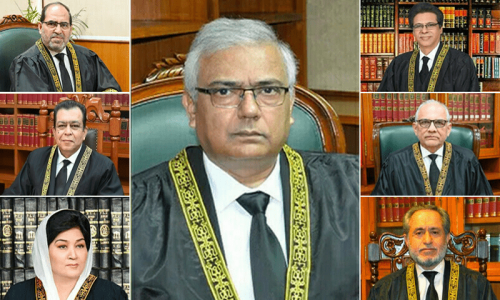
During Monday’s hearing, the seven-member bench led by Justice Aminuddin Khan heard arguments from Haris, who challenged court decisions, including some by former judge Saeed-uz-Zaman Siddiqui.
“If any civilian damages military property, or steals a tank, they will be in violation of the Army Act,” Haris said.
In response, Mandokhail remarked that first information reports (FIR) are filed for any criminal action, but the question was about where the suspect would be tried. Haris replied that lawmakers would decide where the trial takes place.
“We want to know how the FIR is filed, who investigates the case and what the procedure will be,” Mandokhail said.
Haris responded by stating that under the Army Act, the armed forces have the power to arrest civilians, to which Justice Muhammad Ali Mazhar remarked that an FIR must be filed before an arrest.
“When someone is arrested, they must be presented before the relevant magistrate,” Justice Hassan Azhar Rizvi added.
Mandokhail stated, “Under Section 2D of the Army Act, a suspect becomes an accused only when an indictment is filed.”
Haris maintained that the Constitution had “unique jurisdiction” to hear court-martials.
“According to you, military courts do not fall under the category of Article 175,” Mandokhail told Haris. “Tell us under which section of the Constitution are military courts?”
Haris said that there were many court decisions regarding court-martials.
“The courts should have only seen whether the trial was in accordance with the constitution,” Mandokhail remarked. “Controlling terrorism is the job of parliament, not the court. The court would think about whether the decision would reduce or increase terrorism, so it would not be able to make a decision.”
The hearing was adjourned for March 8 (tomorrow), where Haris would continue his arguments.
In October 2023, the Constitutional Bench ruled that civilians could not be tried by military courts and declared the military trials of civilians arrested in the wake of the May 9 riots to be null and void.
In December that year, the SC conditionally suspended its October 23 ruling after taking up 38 intra-court appeals, pending a final judgment.