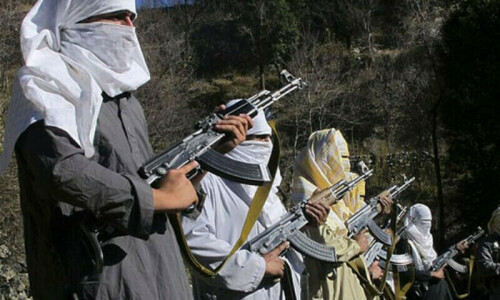
ISLAMABAD: Weapons left behind by Soviet and Nato forces in Afghanistan are still accessible in its eastern provinces, as well as Pakistan’s tribal districts, as restrictions imposed by Kabul are doing little to curb the illicit flow of ammunition, a new research has found.
The paper titled Documenting Arms Availability in Afghanistan, revealed informal arms trafficking involved both older weapons as well as material likely sourced from the equipment delivered to the former Afghan National Defence and security forces.
The research, published by the Small Arms Survey, a Geneva-based organisation, documents arms availability in Afghanistan under the Taliban government.
It is based on field investigations conducted from 2022 to 2024 into the availability and prices of small arms, light weapons, accessories and ammunition at informal markets in the Afghanistan-Pakistan border areas.
The paper says that more than three years since the Taliban takeover and their seizure of the previous regime’s weapons stockpiles, the de facto authorities have strengthened control over commanders and restricted civilians’ and private businesses’ access to arms.
The trafficking has continued — likely with at least the tacit approval of low-level Taliban officials — and evidence suggested the continued arming of UN Security Council-designated terrorist groups, including the banned Tehreek-i-Taliban Pakistan (TTP) and Al Qaeda, alongside efforts to acquire conventional weapons systems on international markets.
The report said the Taliban’s relations with regional terrorist networks, including the TTP and Al Qaeda, further complicate efforts to stop cross-border trafficking.
Weapon prices
Earlier findings from the project documented the ongoing presence of weapons markets in the eastern Afghanistan-Pakistan border areas, pointing to ongoing cross-border weapons smuggling, including involving local Taliban.
Smuggling, along with a well-established network of smugglers, has long existed along this border, with the Taliban frequently purchasing weapons from traffickers during the insurgency.
The report said the dynamics of arms availability and pricing in Afghanistan and neighbouring Pakistan have shifted significantly since late 2021.
While prices in Afghanistan provinces fluctuated over the period monitored, prices in Pakistan remained stable.
In Afghanistan, the cost of a US M4 Nato assault rifle ranged from $2,219 in Urgun (Paktika) to $4,817 in Spira (Khost).
Prices in Nangarhar were nevertheless similar to Khost, since US M4 rifles amounted to $4,379 at the lowest, while AK-pattern rifles amounted to $1,386 at the highest.
In the Durbaba rural district in Nangarhar near the Pakistan border, however, US M4 rifles were on sale for as much as $3,722 and locally made AK-pattern rifles for as little as $218.
In Pakistan, researchers found that the prices of Nato- and Soviet-pattern arms and ammunition remained relatively stable throughout the period and across the different localities.
Although the ongoing Pakistani military operation ‘Azm-i-Istehkam’ is said not to have directly affected weapons prices, local sources indicated that arms dealers were instead simply refraining from openly displaying Nato weapons in local markets due to concerns about arrests and the seizure of arms and ammunition.
The research revealed some weapon-specific trends. For example, the price of M4 rifles increased by around 13 per cent from late 2022 to mid-2024 in Nangarhar and Kunar, with average prices rising from $1,787 to $3,813.
At the same time, M16 rifles rose by 38pc from an average of $1,020 to $2,434.
These increases may reflect reduced supply, increased demand, or a combination of the two.
Conversely, price increases for AK-pattern rifles and RPG-pattern launchers were relatively modest, while prices for Chinese Type 56 rifles decreased slightly, possibly due to increased market availability or reduced demand.
The price for night vision devices, however, has dropped, falling from an average of $2,575 to $781, a decrease of roughly 70pc.
Published in Dawn, April 4th, 2025