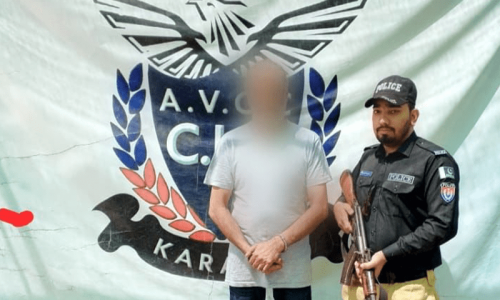
KARACHI: The prime suspect in the Mustafa Amir murder case on Saturday was sent to prison after he refused to record his confessional statement while a magistrate observed that the suspect was not in stable condition to record his confession.
The administrative judge of the anti-terrorism courts sent Armaghan to prison on judicial remand since he said that it was mandatory to send a suspect in judicial custody whether he makes or refuses to make a confession before magistrate.
Armaghan has been booked for allegedly kidnapping and murdering 23-year-old Mustafa Amir in the Defence Housing Authority and torching his body along with the victim’s vehicle in Hub in January.
The investigating officer, inspector Mohammad Ali, filed an application before the magistrate concerned to record confessional statement of the suspect under Section 164 of the criminal procedure code and brought him before the court.
Court rejects IO’s application to record confessional statement of prime suspect in Mustafa Amir murder case
The judicial magistrate (South), Asim Aslam, in his order noted that the suspect was made to sit in his chamber after removing handcuffs and the police officers were directed to leave the premises and one-hour reflection time was given to him.
It also said that the suspect seemed to be tired and lazy and the magistrate informed him that he was not bound to make a confessional statement as the same may be used against him as evidence.
Initially, the suspect said that he wanted to confess his guilt and he murdered Mustafa Amir due to previous grudge, but did not kill him with any planning rather it happened in a sudden outburst, the magistrate in its order added.
However, it also said that when the suspect was informed that he will be remanded to jail custody whether or not he makes the confession, he refused to record his confession and asserted that he was being framed by the “Jewish mafia and the Israeli intelligence agency Mossad”.
The suspect contended that the intelligence agency in question was after him since long and the complainant of the case was also the part of such mafia, it added.
The order further said, “Then again the accused said that he did not kill Mustafa Amir rather left him in the car and burnt only front side of car, he/accused left it to Allah to decide fate of Mustafa Amir. Further, the accused said that the political parties of our country are part of Jewish mafia and they all want to sideline him/accused because he is outspoken against the Jewish lobby”.
In view of foregoing reasons, the magistrate was of the opinion that the suspect was not in stable condition as to record his confession and thereafter, he was declining the application filed by the IO to record confession.
The magistrate also said that the law bound the court to send the suspect to prison, but he was not authorised to decide the custody of the suspect since he was in police custody by the order of the administrative judge of ATCs and directed the IO to immediately produce the suspect before the relevant court.
Thereafter, the suspect was brought before the administrative judge of ATCs Karachi, who sent him to prison on judicial remand.
The judge said that police have also produced the medico legal certificate of the suspect.
It may be recalled that Syed Shiraz Hussain Bukhari, another suspect and alleged accomplice of Armaghan, was also remanded to jail in similar fashion on March 3, when he had also refused to record his confessional statement before a magistrate.
At a previous hearing, the ATC was informed that the main suspect Armaghan, who was in police custody since Feb 18, and he had already recorded his “confession” before a senior superintendent of police under Section 21-H (conditional admissibility of confession) of the Anti-Terrorism Act.
As per the relevant provision, “Notwithstanding anything contained in the Qanoon-o-Shahadat, 1984 or any other law for the time being in force, where in any court proceedings held under this Act the evidence (which includes circumstantial and other evidence) produced raises the presumption that there is a reasonable probability that the accused has committed the offence, any confession made by the accused during investigation without being compelled, before a police officer not below the rank of a District Superintendent of Police, may be admissible in evidence against him, if the Court so deems fit”.
It was also provided that the police officer before recording any such confession, had explained to the person making it clear that he is not bound to make a confession and that if he does so it may be used as evidence against him and that no such confession could be recorded unless the police officer had reason to believe it was made voluntarily.
Published in Dawn, March 23rd, 2025