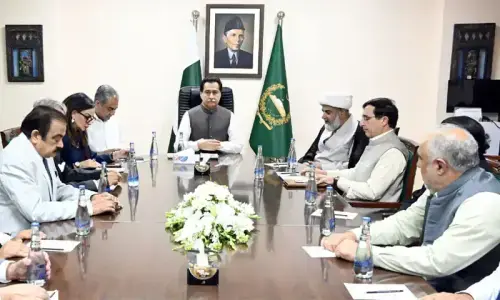
ISLAMABAD: Following the recent visits of ‘President Trump’s advisers for digital assets’, the Ministry of Finance appears to have left the Ministry of Science and Technology high and dry over its months-long endeavour to be the custodian of virtual assets and cryptocurrencies.
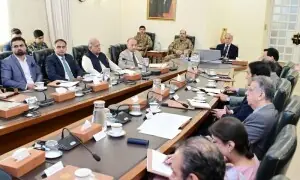
Sources told Dawn that the Ministry of Science, under Dr Khalid Maqbool Siddiqui, has been coordinating with a working group of almost two dozen senior civil and military officials from about 16 stakeholders to prepare for “virtual assets regulations in Pakistan” and had finalised a formal summary to the cabinet for discussions and approval.
These stakeholders include the ministries of science, IT, finance and foreign affairs and regulatory bodies like the State Bank of Pakistan, the Securities and Exchange Commission of Pakistan, and the Pakistan Telecommunication Authority.
Others include the Federal Board of Revenue, Financial Monitoring Unit, Anti-Money Laundering and Counterterrorism Financing Authority and intelligence and investigation agencies. In addition, several experts in digital assets and non-banking financial companies (NBFCs) were also on board.
Finance ministry takes lead in shaping virtual assets
Documents seen by Dawn suggest the working group believes that points 4, 5, 9 and 10 of the Rules of Business 1973 provided the Ministry of Science the mandate with the support of the Ministry of IT to lead the virtual assets regulation in the country.
These points pertain to planning, coordination and promotion of science and technology, monitoring and evaluation of research and development works, including scrutiny of development projects and coordination of development programmes, and promotion of applied research and utilisation of its results in the scientific and technological fields carried out at home and abroad.
These rules also give the mandate to the Ministry of Science to promote scientific and technological contacts and liaison nationally and internationally, including dealings and agreements with other countries and international organisations, and to initiate “promotional measures for establishing venture capital companies for technological development and growth.
This also provides for the creation of NBFCs through the SECP but requires federal cabinet approval to move on.
However, another broad point in the rules of business requires that no matter involving finance could reach the federal cabinet without the prior consent of the Ministry of Finance. Here entered the high-level ‘advisers to President Trump on digital assets’ and the Ministry of Finance’s critical role.
Under the Rules of Business 1973 relating to the Ministry of Finance, all financial matters — including those affecting the country on the whole, like currency, coinage, financial instruments, investment policies, taxes, negotiations with international organisations and so on — fell in the jurisdiction of the finance ministry, although there is no specific mention of digital or virtual assets and cryptocurrencies.
Leveraging its financial jurisdiction, the Ministry of Finance took the lead and moved forward with a proposed Pakistan Crypto Council in the last week of February at a meeting attended by the Ministry of IT but excluding the Ministry of Science.
Adding to the shift, the government announced the appointment of British Pakistani entrepreneur Bilal Bin Saqib as chief adviser to the finance minister on digital assets, a pro bono role.
Sources in the Ministry of Science claim that the game was not over for the ministry and that the finance minister’s chief adviser would actually advise as to which ministry should have the crypto’s responsibility and what the operational way forward should be.
They said the financial matters pertained to the Ministry of Finance, as may be the case with any other ministry or department of the government, but the most relevant ministries to deal with digital assets were the Ministry of Science and, to some extent, the Ministry of IT.
The documents showed the registration of NBFCs would be critical for any crypto to operate in Pakistan in any shape, including an exchange or operator or any other form with the clearance of the SECP.
Officials said the NBFC registration was required before launching an e-wallet due to regulatory, operational, and legal reasons that ensure the safety of the financial system and its users.
This would authorise financial activities to the NBFCs in terms of issuance of electronic money, handling of digital payments and transfers and managing customer funds; otherwise, “such activities would be considered illegal”.
This would also ensure consumer protection in terms of preventing fraud and securing data, compliance with anti-money laundering (AML) and counterterrorism financing (CTF) laws, and facilitating partnerships with banks.
Published in Dawn, March 7th, 2025