Tesla updates autopilot software in China, owners say move falls short of hopes
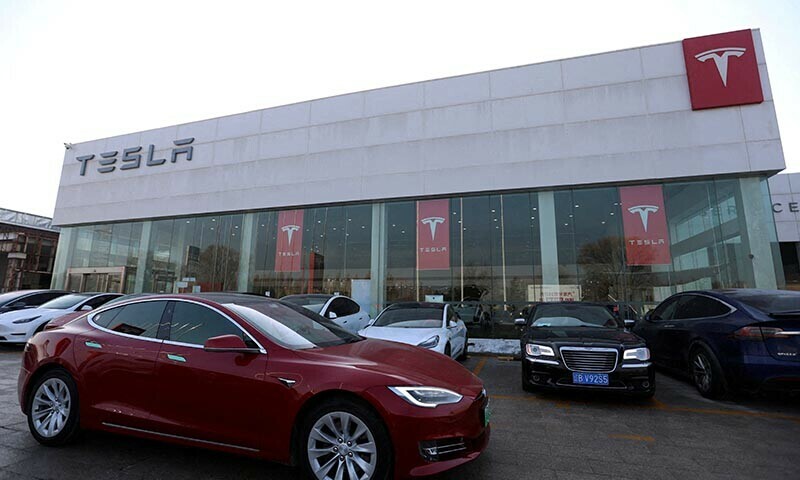
Tesla on Monday made a long-awaited update to its autopilot software in China to add a city navigation feature, but the move disappointed Chinese owners who said it fell short of Elon Musk’s promises.
The US electric vehicle maker, in a notification on its app, said capabilities will include automatic lane-changing depending on speed and route as well as detecting traffic lights at intersections and deciding whether to turn. An in-car camera will also monitor driver attention, it said.
The features are similar to those available with Tesla’s “Full Self-Driving” (FSD) but less advanced than what are available in the United States due to insufficient data training on Chinese roads and traffic rules, a person with direct knowledge of the matter said.
FSD is a suite of driving-assistance technologies developed with generative artificial intelligence to cope with more complicated traffic conditions whereas Autopilot handles more routine conditions.
Musk wants to bring full Autopilot and FSD systems to China but has said that the effort was proving to be tricky due to technology restrictions imposed by both the US and Chinese governments. The company has postponed an initial goal of end-2024 to this year.
Several Chinese social media users said the update was a disappointment as it did not achieve the capabilities Tesla has advertised for years and said rival Chinese automakers were offering similar driver-assistance features at a lower price or for free.
Lu Panpan, a Tesla car owner in China’s eastern Zhejiang province, said he paid 56,000 yuan ($7,720) for FSD software when he bought his Long Range Model 3 in 2019 but has been frustrated by the lack of updates to its features.
“We can tell Tesla has no choice but to deliver a knowingly restricted system … ,” said Lu.
“It is hard for Tesla to catch up with the smart-driving capabilities in Chinese cars, which even makes less sense given its high pricing.”
Falling behind
The delays to rolling out a full FSD system in China have left Tesla on the back foot versus Chinese rivals such as Huawei, Xiaomi and BYD, which have launched dozens of EVs with advanced smart-driving software capable of navigating through China’s complicated city traffic.
Tesla charges its customers an additional fee of nearly $9,000 to access a limited version of its FSD software in its EVs priced from $32,000.
By comparison, Xiaomi, whose SU7 electric sedan priced from $29,700 has outsold Tesla’s Model 3 in China on monthly basis, offers an enhanced smart-driving system including city navigation for free. Earlier this month, BYD also started offering advanced autonomous-driving features on most of its models for free, including ones priced as low as $9,555.
Tesla’s autopilot update is on par with BYD’s mid-tier version of its God’s Eye system, which uses advanced computing and lidars to generate 3D images of a car’s surroundings to assist navigation around obstacles. It is offered in its premium brand Denza and high-end models of its Dynasty and Ocean series.
Musk has said that Tesla is seeking regulatory approval from Beijing to fully roll out FSD in the country, but China currently only requires automakers to register any level-two update with the industry ministry.
Under industry standards, both Autopilot and FSD are categorised as level-two autonomous driving technologies, so under Chinese law they require human supervision and intervention when necessary.
Automakers only need to seek regulatory approval for more advanced level-three and above autonomous driving features.
Musk, however, wanted to be able to transfer data Tesla vehicles glean in China abroad, which is heavily regulated under China’s data laws, Reuters reported previously. Such data, used to train self-driving systems, would boost Tesla’s long-term efforts to produce fully autonomous vehicles.
As part of that effort, Tesla was also developing plans for a data centre in China to train the algorithm needed for more fully autonomous vehicles.