18 dead in New Delhi stampede to catch trains to Kumbh Mela



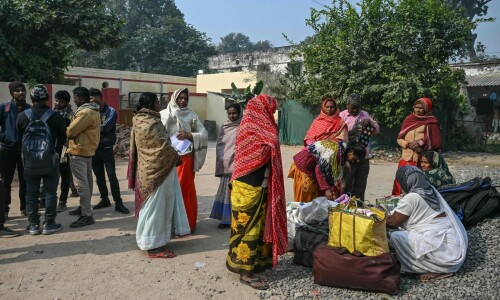
At least 18 people, including five children, died during a stampede at a railway station in India’s New Delhi late on Saturday when surging crowds scrambled to catch trains to the Kumbh Mela, officials and reports said.
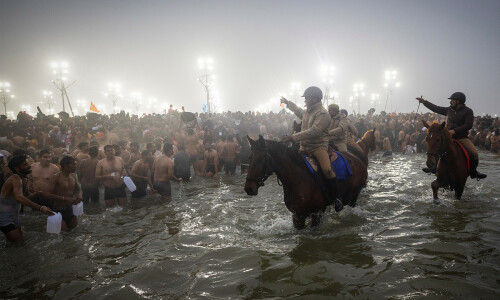
The Kumbh Mela, the world’s largest religious gathering, attracts tens of millions of Hindu faithful every 12 years to the northern city of Prayagraj and has a history of crowd-related disasters — including one last month, when at least 30 people died in another stampede at the holy confluence of the Ganges, Yamuna and the mythical Saraswati rivers.
The stampede occurred at about 8pm (7:30 PKT) on Saturday on two platforms where passengers were waiting to board trains to Prayagraj city, where the Kumbh Mela is taking place, media reports said.
“I can confirm 15 deaths at the hospital. They don’t have any open injury. Most (likely died from) hypoxia or maybe some blunt injury but that would only be confirmed after an autopsy,” Dr Ritu Saxena, deputy medical superintendent of Lok Nayak Hospital in New Delhi told AFP.
“There are also 11 others who are injured. Most of them are stable and have orthopaedic injuries,” she said.
Broadcaster NDTV reported three more dead from the stampede quoting an official of another hospital in the city. The death toll included five children, media reports said, citing the Press Trust of India news agency.
The youngest of the victims was seven years old and the oldest 79, according to multiple media outlets, citing a list provided by police. All but four of the 18 people named were female.
Media showed images and videos of crowds of people falling over each other after the incident, as police and relief teams worked to try and ease the congestion.
Atishi, the chief minister of the national capital territory and who goes by only one name, said on X that many of the victims were pilgrims who were going to attend the Kumbh Mela.

“I have been working as a coolie since 1981, but I never saw a crowd like this before,” the Times of India newspaper quoted a porter at the railway station as saying.
“People started colliding and fell on the escalator and stairs” when the platform for a special train departing for Prayagraj was suddenly shifted, the porter said.
“There was a sea of humanity at the railway station, and the crowd surged towards the train going to Prayagraj,” a distraught woman told the India Today news channel. “I lost my belongings and barely survived.”
Railways minister Ashwini Vaishnaw said a “high-level inquiry” had been ordered into the causes of the accident.
Vaishnaw said additional special trains were being run from New Delhi to clear the rush of devotees.

Prime Minister Narendra Modi said he was “distressed” by the stampede.
“My thoughts are with all those who have lost their loved ones. I pray that the injured have a speedy recovery,” he wrote on X.

The governor of the capital territory Delhi, Vinai Kumar Saxena said disaster management personnel had been told to deploy and “all hospitals are in readiness to address related exigencies.”
The six-week Kumbh Mela is the single biggest milestone on the Hindu religious calendar, and officials said around 500 million devotees have already visited the festival since it began last month.
More than 400 people died after they were trampled or drowned on a single day of the festival in 1954, one of the largest tolls in a crowd-related disaster globally.
Another 36 people were crushed to death in 2013, the last time the festival was staged in Prayagraj.