THE unacceptable loss of at least 22 security men in two separate attacks between Friday and Saturday — in Balochistan and KP — underscore the need to address the problem of terrorism in both provinces with alacrity.
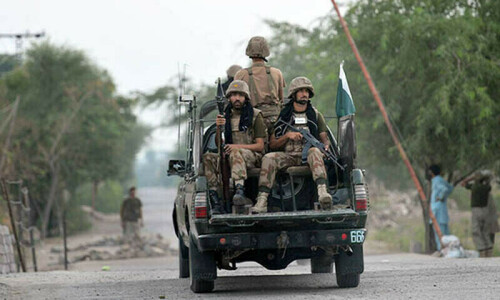
In the first incident, at least 18 paramilitary troops were martyred as they were reportedly ambushed by terrorists in Kalat. In the second episode, four Levies personnel from Balochistan were martyred in KP’s Dera Ismail Khan, near the border of both provinces.
The Kalat atrocity has been claimed by the separatist BLA, and while no group has accepted responsibility for the D.I. Khan attack, the area is known to have a TTP presence. These abhorrent attacks illustrate the fact that the biggest terrorist threat Pakistan faces comes from two major actors: religiously inspired militants, and separatist forces.
Though there is no evidence to suggest that the BLA and TTP coordinated these attacks, some experts have said that the latter may be courting the former to jointly fight the state.
After KP, Balochistan is most affected by militancy. As per one think tank, there were at least 24 terrorist attacks in the province last month, resulting in the loss of 11 security men and six civilians.
The sophistication and frequency of attacks indicate that separatist forces may be getting help from external hostile actors. Undoubtedly, the state’s first priority should be to secure all of Balochistan, and ensure that its people are able to live in peace.
While security operations need to be carried out to ensure terrorist groups cannot operate freely, efforts are also required on the diplomatic front to confront inimical states, and warn them against stoking fires within the country. Moreover, funding and arms transfers to the separatists must be traced and blocked.
Yet, while the state cannot compromise on Balochistan’s security, a distinction needs to be made between the province’s political forces, and separatist militants. Conflating the two is unhelpful, and state action against political activists may actually propel the latter towards militancy.
Poverty, underdevelopment and the issue of enforced disappearances are hard realities in Balochistan.
Therefore, those elements that raise these issues in a democratic fashion should not be demonised by the state. Lately, we have seen terrorism cases filed against Baloch rights activists. Indeed, in the heat of the moment, some activists may use questionable language during rallies and protests, but this cannot be equated with terrorism.
While the state should confront and neutralise actual terrorists murdering security personnel and innocent civilians, an accommodative approach is required where Baloch activists and political forces are concerned.
Though trust between the estranged Baloch population and the state cannot be built overnight, the government’s most potent counterterrorism weapon can be ensuring Balochistan’s full constitutional rights.
Published in Dawn, February 4th, 2025