• White House official John Kirby stresses anti-terror partnership, says no formal treaty exists between two nations
• Trump’s attorney general nominee says global cooperation key to counter Afghan-based terrorist groups
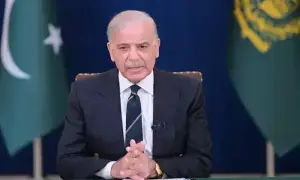
WASHINGTON: Pakistan has played a pivotal role in US counterterrorism efforts over the years, but it has never been a formal ally bound by treaty obligations, senior White House official John Kirby said.
This nuanced positioning underscores the delicate and complex nature of US-Pakistan relations, shaped by shared security concerns and divergent strategic priorities.
Meanwhile, Pam Bondi, President-elect Donald J. Trump’s nominee for attorney general, emphasised during her confirmation hearing on Wednesday that global cooperation would be essential to counter the growing threat posed by Afghanistan-based terrorist groups like ISIS-K.
Her comments mirrored broader concerns in Washington about the evolving regional security dynamics and their implications for US-Pakistan relations.
At a Washington briefing, White House National Security Communications Adviser John Kirby candidly addressed the nature of the US-Pakistan relationship, highlighting the absence of any formal defence pact.
“Pakistan was never a technical ally of the United States. I mean, there was no treaty of alliance with Pakistan,” he stated in response to a question.
Despite this, Kirby emphasised the long history of cooperation between the two countries, particularly in combating terrorism in the volatile Afghanistan-Pakistan border region. “Certainly, over many, many years in the last couple of decades, we partnered with Pakistan as appropriate to deal with the terrorist threat that still exists on that spine between Afghanistan and Pakistan,” he explained.
In August last year, State Department spokesperson Vedant Patel reaffirmed the US’s commitment to preventing groups like the banned Tehreek-i-Taliban Pakistan (TTP) from using Afghanistan as a base for launching terrorist attacks against neighbouring countries.
The next month, State Department spokesperson Matthew Miller asserted that the US would continue to stand “shoulder to shoulder with Pakistan in its fight against terrorism”.
A US State Department report released in December noted that Pakistan has made substantial progress in countering terrorist financing and addressing regional extremist networks.
At the same time, Kirby also acknowledged the human cost of terrorism in Pakistan, recognising that its citizens continue to suffer from cross-border violence.
“We recognise that Pakistan is still — still the Pakistani people fall victim to terrorist violence coming from across that border.
“And we have, and for as long as we’ll be in office here, remain committed to working with Pakistan to address those common threats and challenges. And that’s not — that hasn’t changed. It’s not going to change,” Kirby said during the briefing.
Separately, Bondi assured lawmakers that the Trump administration would remain committed to combating groups like ISIS-K, a stance consistent with prior administrations.
When questioned by Senator Lindsey Graham about the United States’ position on ISIS, Bondi unequivocally stated, “Of course, we are at war with ISIS.” She further agreed with Graham’s assertion that ISIS is similarly at war with the US.
The senator also shifted the discussion towards ISIS-K, citing statements from US generals with experience in Afghanistan. These generals warned that ISIS-K has both the capability and intent to target the US and Western interests, noting its increased strength in Afghanistan following the US withdrawal in 2021. Bondi concurred, stating, “From everything I have heard and read, ISIS is one of the greatest threats.”
Bondi’s call for enhanced coordination among US agencies and global partners to combat ISIS-K underscores the complexity of maintaining effective counterterrorism efforts in a region marked by volatile geopolitics. Her remarks also reflect the intricate nature of US-Pakistan relations, shaped by mutual security concerns yet tempered by strategic divergences.
Published in Dawn, January 16th, 2025