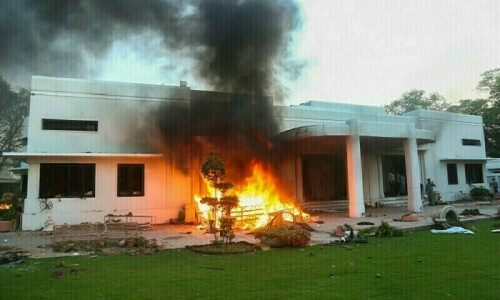
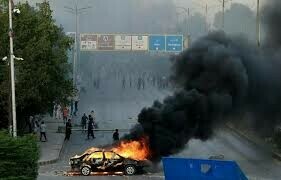
THE sentencing of 25 civilians by military courts for their involvement in the May 9, 2023, riots raises questions about justice and due process in Pakistan.
While the ISPR statement says these convictions represent “an important milestone in dispensation of justice”, a closer examination reveals certain gaps, including the question of jurisdiction.
The Official Secrets Act, which was invoked for conducting these trials, primarily deals with espionage and unauthorised disclosure of classified information. The act of attacking military installations or Jinnah House, though undoubtedly reprehensible, does not naturally fall within the OSA’s ambit. Instead, the Anti-Terrorism Act and Pakistan Penal Code are applicable to acts of violence. It has not been explained how these specific cases, some resulting in sentences as light as two years, warranted military trials while hundreds of similar cases proceed in anti-terrorism courts.
According to ISPR, “all legal rights” were afforded to the accused. However, this appears inconsistent when examined against the basic principles of due process. Can serving officers, bound by military hierarchy, truly provide independent judgements? The one-line descriptions of convictions accompanying the names of the 25 individuals hardly qualify as reasoned judgements.
Moreover, the stance that convicts “retain the right to appeal” overlooks a crucial fact: appeals from FCGM lie with military appellate courts and ultimately the army chief, not the civilian courts that can only review these cases on limited grounds like mala fide or lack of jurisdiction and without the power to reassess evidence or findings of guilt.
This newspaper has consistently opposed military trials of civilians as fundamentally incompatible with democratic principles. The Supreme Court’s landmark October verdict declaring such trials unconstitutional reflected this position. While that verdict stands unoverturned on appeal, the constitutional bench has allowed the military courts to announce decisions, creating troubling legal uncertainty.
The fundamental questions about trying civilians in military courts and whether the May 9 incidents fall under military jurisdiction remain undecided, casting a long shadow over these convictions’ legitimacy.
The gravity of the May 9 incidents is not in question. Those responsible for attacking military installations must face justice. And the people deserve the truth regarding the riots. This can only be accomplished with transparent, fair trials in civilian courts. Secret military trials of select accused, conducted under questionable jurisdiction and with opaque appeal rights, makes the exercise appear more about reprisal than justice. That such trials are occurring under civilian leadership adds a layer of irony to this distressing situation.
Pakistan’s democracy, still finding its feet, cannot afford such compromises on core democratic values. The Supreme Court must now demonstrate the judicial leadership the moment demands by definitively settling these fundamental questions about military trials of civilians. Pakistan’s democratic future depends on it.
Published in Dawn, December 22nd, 2024