ISLAMABAD: The Foreign Office on Saturday strongly rejected the United States’ criticism of Pakistan’s long-range ballistic missile programme, calling it irrational and devoid of historical context as it vowed to continue developing its missile capabilities in line with its credible minimum deterrence strategy, emphasising their necessity in the face of evolving threats from India.
“The alleged threat perception from Pakistan’s missile capabilities and delivery means, raised by the US official, are unfortunate,” said FO spokesperson Mumtaz Zahra Baloch. “These allegations are unfounded, devoid of rationality and sense of history.”
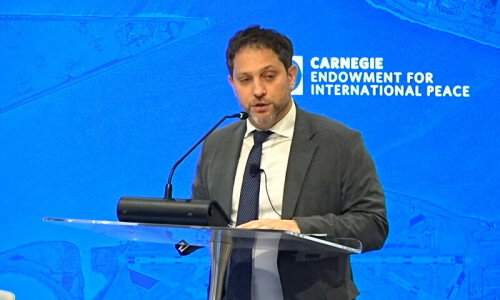
The spokesperson was commenting on US Deputy National Security Adviser Jon Finer’s remarks, delivered at the Carnegie Endowment for International Peace, in which he accused Pakistan of developing long-range ballistic missiles capable of striking targets beyond South Asia, including the US. “It’s hard for us to see Pakistan’s actions as anything other than an emerging threat to the United States,” he said, citing increasingly sophisticated missile technology and development of larger rocket motors.
The spokesperson reiterated that Pakistan’s strategic programme is solely designed to preserve peace and stability in South Asia. “Pakistan’s strategic capabilities are meant to defend its sovereignty. We cannot abdicate our right to develop capabilities commensurate with the need to maintain credible minimum deterrence and address evolving threats,” she added.
Allegations termed ‘unfounded, devoid of rationality and sense of history’
Ms Baloch highlighted the extensive dialogue between Pakistan and the US on this issue, noting efforts to address Washington’s concerns. “Since 2012 when the US officials started broaching the subject, different Pakistani governments, leadership and officials, have endeavoured from time to time, to positively address and remove the misplaced US concerns,” she said. “Pakistan has also made it abundantly clear that our strategic programme and allied capabilities are solely meant to deter and thwart a clear and visible existential threat from our neighbourhood and should not be perceived as a threat to any other country,” she said, referring to the dialogue between the two countries on the issue in recent years.
She strongly criticised attempts to question Pakistan’s intent, warning that any intrusion into its strategic programme was neither acceptable nor possible. “There is unshakeable resolve and complete consensus on this aspect across the entire political and social spectrum of the country.”
The spokesperson lamented that Pakistan was being unfairly bracketed with adversarial nations. “It is regrettable that the US official alluded to bracketing Pakistan with those who are perceived to be in an adversarial relationship with the US,” she said, in a veiled reference to comparisons with Russia, China, and North Korea. “Any irrational assumption of a hostile intent from Pakistan by any other country including the US is perplexing as well as illogical.”
Ms Baloch also underscored the longstanding cooperative relationship between Pakistan and the US, cautioning that recent allegations could damage bilateral ties. “Since 1954, Pakistan and the US have enjoyed a positive and broad-ranging relationship.
The recent spate of US allegations towards a major non-Nato ally would be unhelpful for the overall relationship, especially in the absence of any evidence in this regard,“ she said.
“Pakistan has never had any ill-intention towards the US in any form or manner, and this fundamental reality has not changed,” she asserted The FO spokesperson pointed to the sacrifices Pakistan has made for the bilateral relationship, particularly in counterterrorism efforts and addressing regional instability. “On the contrary, Pakistan has made monumental sacrifices for this relationship and continues to suffer hugely in sustaining the onslaught of the aftermath of US policies in the region,” she explained.
At India’s behest
Pakistan expressed concerns that the criticism was influenced by India’s interests, further destabilising regional security.
“While ignoring and shielding the manifestations of a much more potent missile capability in our eastern neighbourhood, concerns on Pakistani capabilities are being raised seemingly at the behest of others to further accentuate the already fragile strategic stability in the region,” the spokesperson said.
The Biden administration has implemented four rounds of sanctions since October 2023 targeting entities linked to Pakistan’s missile programme, including the state-run National Development Complex. The FO decried these actions as unjustified and detrimental to regional peace.
Pakistan reaffirmed its commitment to constructive engagement with the US on security and stability issues. “We have a long history of cooperation and wish to build on this strong legacy,” she maintained.
Published in Dawn, December 22nd, 2024