• Calls for lifting of sanctions on his country, de-listing of his group as terrorist organisation
• Supports women education, avoids definitive answer if alcohol consumption will be allowed
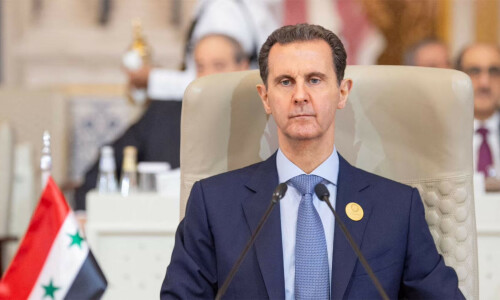
THE de facto leader of Syria, Ahmed al-Sharaa, has urged the international community to lift sanctions on the war-torn country, stressing that Syria “is no longer a threat to its neighbours or the West”.
“Now, after all that has happened, sanctions must be lifted because they were targeted at the old regime. The victim and the oppressor should not be treated in the same way,” he told Jeremy Bowen, the international editor of BBC News, in an interview in Damascus.
After attracting little notice for years, Sharaa — previously known by his nom de guerre of Abu Mohammed al-Jolani — spearheaded a stunning lightning offensive that led to the fall over the weekend of the regime of Bashar al-Assad of Syria after over 13 years of brutal civil war.
Sharaa, 42, is the leader of Hayat Tahrir al-Sham (HTS), a group once linked to Al Qaeda that has controlled most of Idlib Province, in northwestern Syria, for years during a long stalemate in the conflict.
The group is designated as a terrorist organisation by the UN, US, EU and UK, among many others. The US government still offers a $10 million bounty for Sharaa.
Sharaa told BBC News that HTS was not a terrorist group and should be de-listed as one. He insisted that HTS did not target civilians or civilian areas, claiming instead that it was a victim of Assad-era atrocities.
Vision for Syria
Sharaa rejected comparisons to Afghanistan under Taliban rule, highlighting the cultural and societal differences between the two nations. “Afghanistan is a tribal society. In Syria, we have a different mindset,” he said.
He said he believed in education for women. “We’ve had universities in Idlib for more than eight years,” Sharaa said. “I think the percentage of women in universities is more than 60 per cent.”
When asked about contentious issues such as alcohol consumption, Sharaa avoided giving a definitive answer. He explained that such matters would be decided by a “Syrian committee of legal experts” tasked with drafting a new constitution. “They will decide, and any ruler or president will have to follow the law,” he added.
In an interview earlier this week with a group of foreign journalists, Sharaa said the top priority was rebuilding Syria, for which, the lifting of international sanctions was essential. The economic sanctions were imposed on the “executioner” of the Syrian people, said Sharaa, referring to Assad.
“We Syrians, the victims, are being punished for the acts of our executioner, who is no longer with us,” he said, according to a FRANCE 24 report. “We ask for the international community’s help in prosecuting the Assad regime’s criminals and recovering the money stolen from Syrians.”
‘No conflict with Israel’
Israel has carried out more than 470 strikes on military sites in Syria since Assad fled, according to the Britain-based Syrian Observatory for Human Rights.
Sharaa called on the international community to give Syria a chance to create its own destiny after the 13-year civil war drew regional and global powers into the battlefield in a proxy war that devastated the country.
“Israel had the alibi to strike in Syria,” said Sharaa, referring to Iran-backed militias that helped the Assad regime during the civil war. “These militias are no longer there,” he said.
“We don’t want conflict either with Israel or with other countries. Syria won’t be used to target other countries. Syrians are tired and just need to live in peace.”
National unity was a top concern for a post-Assad Syria, noted Sharaa, and this extended to Syria’s Kurds, who currently run a semi-autonomous administration in the country’s northeast.
Published in Dawn, December 20th, 2024