0
0

ISLAMABAD: Deputy Chief of Mission at the Chinese Embassy Shi Yuanqiang on Monday said that the China-Pakistan Economic Corridor (CPEC) had transformed Pakistan, making it an attractive destination for direct investment.
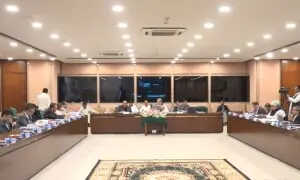
He was speaking at a seminar titled ‘10 Years of CPEC: Success, Opportunities and Challenges’ organised by the Asian Institute of Eco-civilization Research and Development (AIERD).
Shi Yuanqiang said over the last 11 years, CPEC had brought $25 billion in direct investment, and now it had entered a new phase of development.
“China-Pakistan Economic Corridor has gone through an extraordinary process since its launching. The layout of CPEC construction set by President Xi Jinping and the Pakistani leaders has turned into a reality from a blueprint with a wide range of achievements. Energy cooperation has yielded remarkable results. The total installed capacity of the 14 energy projects that have been commercialised in operation accounts for about 1/5 of the total installed power capacity of Pakistan. The units of the SK Hydropower Station have been connected to the grid to generate electricity,” he said.
Says project brought $25 billion in direct investment in 11 years
“The Orange Line has helped the people of Lahore realise their dream of having a subway. The year-round opening of the Khunjerab Pass will ensure the all-weather economic and trade exchanges between our two countries. Construction and operation of Gwadar Port and its industrial free zone are progressing steadily, and completion of the Gwadar New International Airport will fully release the development potential of Gwadar Port. Industrial cooperation is another promising area: the first phase of the Rashakai Special Economic Zone has been in operation, generating strong momentum in Pakistan’s industrial development,” he said.
Special Investment Facilitation Council (SIFC) Secretary Jamil Qureshi said 10 years ago, the monumental CPEC project began as a vision.
“Today, it has become a reality and has already started to reshape the economic landscape of Pakistan and the broader region. CPEC is not a collection of infrastructure projects; it is a vision for Pakistan’s future - a future where industries thrive, where employment opportunities are abundant, where technology is at the forefront of growth, and where economic relations reach new heights,” he said.
“We are pleased to witness the progress and the development of Rashakai SEZ in Khyber Pakhtunkhwa, Dhabeji SEZ in Sindh, M3 Allama Iqbal in Punjab and Bostan SEZ in Balochistan as they are all in the advance stages of development,” he added.
Rawalpindi Chamber of Commerce and Industry President Usman Shaukat suggested enhancing the potential of the project.
“Gwadar International Airport would bring more connectivity to people of different regions with Gwadar. But, we also need to work on more linkages between the industries of Pakistan and China,” he added.
Mr Shaukat said the API (active pharmaceutical ingredients) industry still has a lot of potential.
“Pakistan does not manufacture any of those and we are completely reliant on the imported sources for the raw material,” he said, adding that “the APIs are something that the pharmaceutical industry absolutely needs to move forward.”
He said since China was the leader in the API industry, Pakistan can have a lot of projects under CPEC to bring the technology transferred to Pakistan.
AIERD Chairman Zahid Latif Khan said that in 2016, the three stock exchanges of China had taken 40pc stake in the Pakistan Stock Exchange.
Retired Maj Gen Samrez Salik said CPEC was an essential segment of the BRI. He said that Pakistan was a frontline state in 20th-century geopolitics, which played havoc. Pakistan needed to realise that to unlock CPEC’s potential, it will have to ensure security for Chinese personnel and Chinese projects, he said.
Speaking on the topic of CPEC and Gender, Nabila Jaffar said that CPEC cannot be considered a game-changer without the active and effective participation of women in these initiatives.
Shakeel Ahmad Ramay, CEO of AIERD, concluded the seminar by quoting a study by AIERD; if there were no CPEC energy projects, Pakistan would be losing $15-20 billion annually.
Published in Dawn, December 17th, 2024