Israel, US carry out air strikes in Damascus after regime change


• Imposes curfew in five towns of the demilitarised buffer zone between Israel and Syria
• Tehran calls for national dialogue to form new govt; its embassy in Damascus ransacked
JERUSALEM: Israel conducted three air strikes in the Syrian capital on Sunday against a security complex and a government research centre which it has said in the past was used by Iran to develop missiles, two regional security sources told Reuters on Sunday.
The strikes caused extensive damage to the main customs headquarters and buildings adjoining the military intelligence offices within the security complex, which is located in the Kafr Sousa district of Damascus, the sources said. The research facility was also damaged, they said, speaking on condition of anonymity.
One source said the strikes had hit infrastructure used to store sensitive military data, equipment and guided missiles parts.
Earlier on Sunday, Israel struck at least seven targets in southwest Syria that included the Khalkhala air base north of Sweida city that Syrian army troops withdrew from last night, the sources said.
Strikes near Mezzah military airport southwest of the capital hit other ammunition depots, the sources said.
On the other hand, the US Central Command (CENTCOM) claimed its forces conducted more than 75 air strikes in central Syria on Sunday. American warplanes struck over 75 Islamic State targets in Syria on Sunday, hitting the group’s leaders, operatives and camps, the US military said.
Strikes were carried out against “over 75 targets using multiple US Air Force assets, including B-52s, F-15s, and A-10s,” the US Central Command said on social media. The CENTCOM said its strikes were aimed to ensure that the Islamic State does not take advantage of the current situation in Syria.
Order to ‘seize’ buffer zone
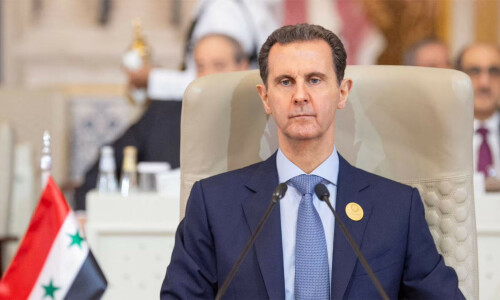
Earlier, Israeli military imposed a curfew in five Syrian towns in the Golan Heights after Benjamin Netanyahu ordered it on Sunday to “seize” the demilitarised buffer zone on the border with Syria following the overthrow of Bashar al-Assad.
The Israeli premier said a 50-year-old “disengagement agreement” between the two countries had collapsed and “Syrian forces have abandoned their positions”.
“For your security you must stay at home and not go out until further notice,” Israeli army spokesman Lt Col Avichay Adraee said on X (formerly Twitter) in a message for residents of the Syrian localities.
On Sunday, Netanyahu said he had directed the IDF to seize the buffer zone and the commanding positions nearby.
The announcement, which Netanyahu made while visiting the Israeli-occupied Golan Heights, came after the military said it had deployed forces to the area.
Since the rebel coalition, led by Islamist group Hayat Tahrir al-Sham, began its renewed offensive against government forces on Nov 27, Syrian government forces have left positions near the Israel-held Golan, according to a war monitor.
Most of the plateau has been occupied since 1967 by Israel, which later annexed it in a move not recognised by most of the international community.
In 1974, the buffer zone was established, separating the Israeli-held and Syrian territories, with UN peacekeepers stationed there since.
A UN Peacekeeping spokesperson said on Saturday that UNDOF personnel had observed “unidentified armed individuals in the area of separation, including approximately 20 who went into one of the mission’s positions in the northern part of the area of separation”.
The UN spokesperson said that “peacekeepers continue to carry out their mandated activities on the Golan”.
Iranian reaction
Meanwhile, the Assad regime’s ally Iran said on Sunday that Syria’s fate is the sole responsibility of the Syrian people and should be pursued without foreign imposition or intervention.
Iran’s foreign ministry has called for a national dialogue to form an inclusive government representing all segments of Syrian society. The foreign ministry said it expected ties between Tehran and Damascus to continue based on the two countries’ “far-sighted and wise approach.”
But on Sunday morning, assailants rummaged through furniture and documents at the Iranian embassy in Damascus, according to footage shared by the Saudi Al Arabiya channel.
An AFP photographer saw ransacked offices, with shattered glass on the floor and broken furniture in the building in Mazzeh area, also home to other embassies and United Nations offices.
Tehran Times reported that Iranian diplomats had left the embassy before it was stormed, citing foreign ministry spokesman Esmaeil Baqaei.
Published in Dawn, December 9th, 2024