0
0

ISLAMABAD: Amid discussions over increase in retirement age for selective positions, the government is also examining reducing the average age of superannuation by five years to 55 for containing long-term pension bill.
This is one of the proposals suggested by an international lender and currently under federal government’s consideration as part of wider pension reforms, a senior government official told Dawn.
Interestingly, the finance ministry had last year proposed increasing the superannuation age by two years to 62 for temporary delays to payments on account of retirement benefits, but it was opposed by the establishment division.
At present, pension to government servants is worked out on the basis of the last drawn basic salary at the age of 60 and in some cases capped at maximum of 30 years of service.
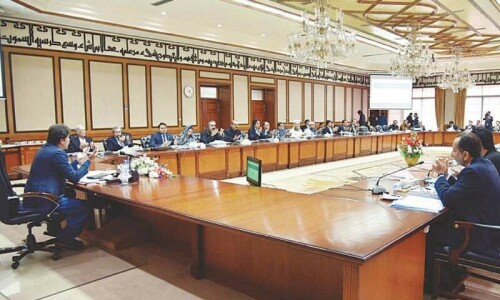
At a meeting last week presided over by Finance Minister Muhammad Aurangzeb, the Economic Coordination Committee (ECC) of the cabinet had expressed concern over delays in implementation of its May 27 and June 13 instructions for amendments to the pension scheme and future roadmap and a report of the Pay & Pension Committee.
The decision remains unimplemented so far and the meeting was told that it would take more time in view of detailed consultations required with multiple stakeholders.
Move among proposals suggested as part of wider pension reforms
The pension payout could drop in case of reducing the age of retirement by five years, thus reducing the pension liability expense by an estimated Rs50bn per annum if implemented across the board.
Given the initial increase in expenditure that would arise because of early severance packages, the government would consider a phased implementation. This could also facilitate mobility of experienced and skilled public sector employees to the private sector.
At present, the federal pension bill goes beyond Rs1 trillion, including a civil and armed forces share of about Rs260bn and about Rs750bn, respectively. To stop the increasing flow of annual pension bill, the government has recently introduced a contributory pension scheme for all future government employments.
While the government is examining legal and financial pros and cons of introducing such a scheme for federal government employees and its adoption by the provincial governments, it would be asking the public sector corporations, regulatory authorities and professional councils to decrease retirement age for their employees.
The federal government would not be responsible for the payment of retirement benefits or severance packages as the case maybe and these agencies would take care of financial requirements from their own resources or external innovative options.
Informed sources in the finance ministry said a leading multilateral had suggested that decreasing the age of retirement by five years could have a positive impact on the pension budgetary head. Potential benefits included reduced pension liability and savings on pension payments.
With a lower retirement age, the government would be required to pay pensions for a shorter duration-based calculation, potentially reducing the overall pension liability in the long term. Also, by retiring employees earlier, the government would save on pension payments as the number of years for which pensions are paid out could reduce.
The proposal is not without potential drawbacks. This means that implementing a lower retirement age could lead to increased upfront costs (as a result of a larger number of early exits), such as severance packages or retirement benefits, which might offset some of the potential long-term savings.
Also, a lower retirement age could lead to a loss of experienced human capital in the government, potentially affecting workforce productivity and efficiency, besides additional impact on social security systems.
Officials said the retirement age in countries such as India, Malaysia, Indonesia, Thailand, the Philippines, Sri Lanka and even Brunei ranged from 55 to 58 years and in some cases to 60.
According to a recent study by Pakistan Institute of Development Economics — a public sector think tank — the government pension expenditure whether it is federal, military, or provincial is going out of control and is mostly unfunded. It has increased from Rs164bn in 2011 to Rs988bn in 2021.
“The federal government’s expenditure (including that of military) on pensions has increased more than five times during the last 10 years. On the other hand, provincial pension expenditure has increased more than seven times. Contrary to that, tax revenues have increased only 2.7 times during the same period”, pointing out sustainability risks, the study observed.
Published in Dawn, December 2nd, 2024