Unrestricted freedom of speech contributing to degradation of moral values in societies: army chief



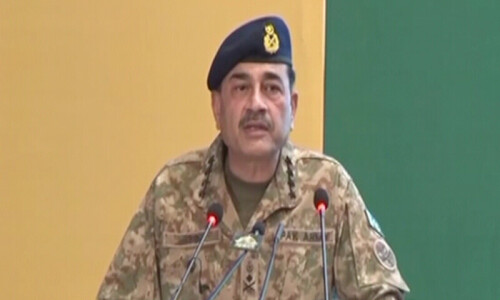
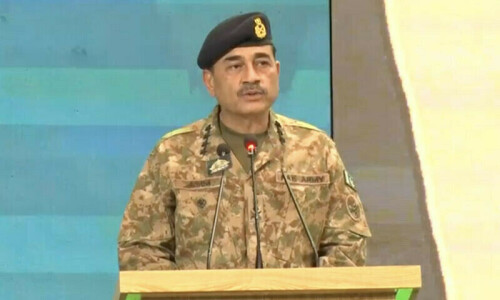
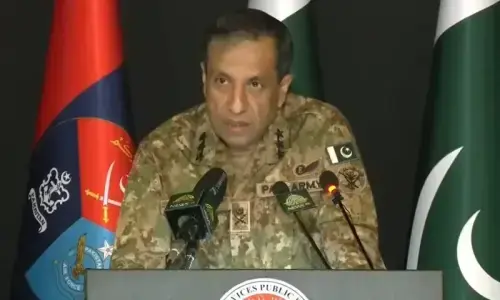
Chief of Army Staff (COAS) General Asim Munir on Friday addressed the impact of technology in spreading false information, reiterating that unrestricted freedom of speech was “contributing to the degradation of moral values in all societies.”
Gen Munir was speaking on the topic of “Pakistan’s role in peace and stability” at the Margalla Dialogue 2024 in Islamabad, organised by the Islamabad Policy Research Institute (IPRI).
According to a statement issued by state broadcaster PTV on X, the army chief said, “Unrestricted freedom of speech is leading to the degradation of moral values in all societies.”
He said that while technology had played an important role in the dissemination of information, “the spread of misleading and incorrect knowledge was a major challenge”.
“Without comprehensive laws and regulations, false and misleading information, and hate speech will continue to destabilise political and social structures,” he said.
Today’s statement was the latest in a long line of warnings from the army chief and the military about the dangers of misinformation, that particularly spreads through social media posts.
Over the past couple of years, social media campaigns against the army have escalated, reflecting broader tensions within the country’s political and social fabric. The government, often in tandem with the military, has responded with stringent measures aimed at controlling the narrative and stifling dissent.
These measures have led to numerous arrests and legal actions against journalists and social media users accused of spreading “negative propaganda” about the military and the state, resulting in restricted internet access and bans on platforms like X.
Previously, Gen Munir warned that social media was being exploited to spread anarchy and false information aimed at the armed forces, while the term ‘digital terrorism’ is now being used to describe the actions of online critics accused of spreading falsehoods.
In August, during an Independence Day speech, the army chief stressed the importance of investigating and verifying information so as not to cause consternation among the people.
He had said that while the Constitution allowed for freedom of speech, it also contained “clear limits to what constitutes free speech.”
“To the inimical forces, let it be clear; that regardless of the multilayered and multidimensional threats piled up against us we stand united and reassured. Traditional or non-traditional, dynamic or proactive, whatever form of warfare is applied against us, our retribution will be sharp and painful and we will certainly strike back,” he had said.
“For indeed, we know that freedom is not for free, it costs many great sons and daughters, and we are always ready for that. I have full faith and confidence that the people of Pakistan and its security forces will never relent and let anyone cast an evil eye on this great country.”
‘TTP home to all terrorist proxies worldwide’
During his speech, Gen Munir also talked about how violent non-state actors and state-sponsored terrorism had become major global challenges.
“Terrorism is a common challenge for all humanity globally, and Pakistan has an unwavering commitment to the fight against terrorism,” he said.
He also stated that a robust border management system had been implemented to secure Pakistan’s border with Afghanistan against Fitna al Khawarij, who he said was “home to all the terrorist organisations and proxies of the world”.
In July, the government, through an official notification, designated the banned Tehreek-i-Taliban Pakistan (TTP) as Fitna al Khawarij, while mandating all institutions to use the term khariji (outcast) when referring to the perpetrators of terrorist attacks on Pakistan.
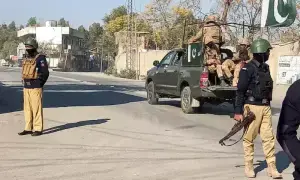
The country has lately witnessed a sharp uptick in the number of attacks targeting security forces, other law enforcement agencies, and security checkpoints, particularly in Balochistan and KP.
Attacks escalated after the TTP broke a fragile ceasefire agreement with the government in 2022 and vowed to target security forces.
Islamabad maintains that the TTP uses Afghan soil to launch attacks in Pakistan and has repeatedly asked Kabul to deny safe havens to the outlawed group and to hand over its leadership to Pakistan. Afghanistan has denied the allegations.
“Pakistan expects the Afghan Interim Government not to allow Afghan territory to be used for terrorism and to take strict measures in this regard,” Gen Munir reiterated today.