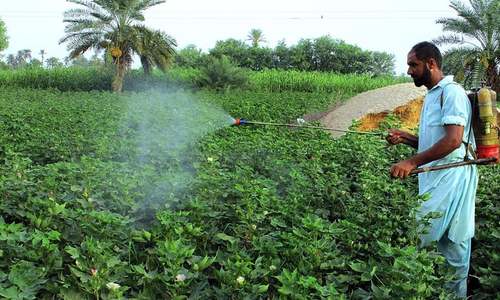
A national policy dialogue on strengthening agriculture innovation systems for providing agricultural machinery to Pakistan’s small farmers — initiated by the Food and Agricultural Organisation (FAO) — has identified the absence of a national policy on agriculture mechanisation as a prime reason for low farm productivity.
The government should promote the formation of farmer cooperatives to pool resources, share knowledge, and jointly invest in machinery, according to an FAO document released on Oct 22. It recommended developing and disseminating low-cost mechanisation solutions through partnerships, cooperative models, and policy dialogue. The International Monetary Fund (IMF) notes that Pakistan’s agriculture policies have a very minor portion related to agricultural mechanisation.
Farm experts say that mechanised farming is neither feasible nor possible on small farms. It is cooperative farming, which can be made possible by consolidating small holdings into enlarged farm sizes. Sindh’s Chief Minister, Syed Murad Ali Shah, has recently advised the provincial agriculture department to find ways to provide machinery to small farmers.
While tractor use is widespread, FAO notes, farmers do not have the right implements. They need them at all stages of the production cycle, from ploughing to sowing to grading. Better and targeted farm credit would increase the use of machinery.
Cooperatives can make mechanised farming possible in small holdings that are otherwise neither feasible nor possible
The use of modern machinery and implements can be effectively promoted by encouraging corporate farming sponsored by big local farmers and cooperative farming sponsored by small growers. Agricultural modernisation has a critical role to play in the sector transitions towards industrialisation, says Sindh Agricultural University Vice-Chancellor Dr Fateh Marri.
The World Bank estimates that Pakistan produces only 130 grams of crop per cubic meter of water. This contrasts with 300 grams for India and 800 grams for China. It estimates current direct and indirect subsidies for agriculture in Pakistan at about $2.5 billion per year, yet the amount has done little to make the sector competitive.
The bulk of the subsidies go to the big landowners who also pay very little income tax, which could be ploughed back as investment for the uplift of agriculture. Despite being predominantly an agricultural country, Pakistan imported farm goods worth $8.5bn and exported goods worth $7.4bn in FY24.
Countries that introduced effective land reforms to unleash the potential of corporate and cooperative farming based on the latest technologies increased their crop yield per acre at an unprecedented pace and created a huge middle class while widening prosperity in the countryside. High economic growth in China and India can be explained by timely land reforms.
Though weakened by the country’s industrialisation and urbanisation, the outdated agricultural mode of production in Pakistan — a legacy of colonial rule — is the major obstacle to raising farm productivity.
Pakistan produces only 130 grams of crop per cubic meter of water, compared to 300 grams for India and 800 grams for China
A cooperative, as defined by FAO experts, is an autonomous association of men and women, united voluntarily to meet their common economic, social and cultural needs and aspirations through a jointly owned and democratically controlled enterprise. It is a business enterprise that seeks to balance between pursuing profit and meeting the needs and interests of members of the communities.
Tested on a tiny scale, according to studies by Pakistani experts, cash crop farmers who were part of a cooperative in Punjab witnessed an increase in the yield, with a 38 per cent higher benefit-cost ratio than non-cooperative growers. Similarly, a cooperative set up in Khairpur, Sindh, saw farmers adopt modern techniques for growing vegetables and fruits.
The cooperative also linked the farmers with vegetable exporters and supermarkets in Karachi and Lahore, thus helping their sales. The cooperatives pool resources by acquiring management of member’s land and/or acquiring rights to provide seeds, fertilisers, water, machines, and/or sales of farm produce.
To quote Dr Hafiz A. Pasha, the distribution of farmland in the country is very skewed: 1pc farms account for 22pc of the farm area at the top of the distribution. It is worth noting here that lands resumed by the state under land reforms and allotted to small farmers, many of whom had no funds and no financing facility to bring the holdings under the plough, were bought by big landowners.
In a report on “Protection issues faced by women farmers in Pakistan”, FAO researchers point out that female labour tends to be undocumented, and they are rarely referred to as ‘farmers’, unlike their male counterparts. The current understanding of who a ‘farmer’ is tends to consider that these individuals own the land they work on.
However, this excludes huge numbers of farmers — particularly women — which prevent them from accessing vital benefits and services. The contributions of women farmers to the agricultural sector, food security and the economy are largely unrecognised.
As national and international discourse tends to focus on ideas and solutions with a future, countries lacking futurist outlooks, like Pakistan, are trailing behind the march of events.
Today, more than 12pc of the world’s population are members of three million cooperatives, providing 280m jobs worldwide. The world’s 300 largest cooperatives have a global turnover of about $2 trillion.
Published in Dawn, The Business and Finance Weekly, November 4th, 2024