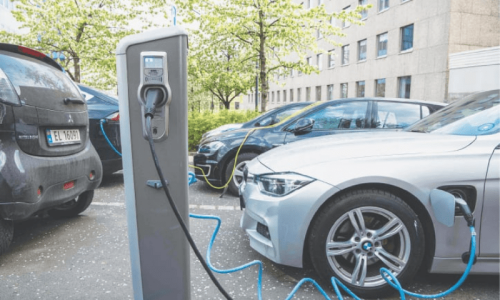
KARACHI: The launch of expensive hybrid electric vehicles (HEVs) and electric vehicles (EVs) back-to-back by old and new entrants suggests that the country has emerged from tough economic times and that the living standards have improved. However, the dynamics of the auto market are entirely different.
Without doing any demand analysis, the government is also trumpeting that introducing these new energy vehicles (NEVs) will curtail petrol and diesel imports.
These sleek and stylish HEVs and EVs with multiple choices are either being imported or assembled locally only for a “limited elite class” rather than for the mass population of lower- or middle-income.
The rich class habitually changes vehicles in one or two years. Many of them already own costly petrol and diesel-driven SUVs and sedans like Toyota Fortuner, Toyota Corolla, Honda Civic, Toyota Revo, Kia Sportage, Hyundai Tucson, MG and Changan Oshan, Honda HR-V, Hyundai Elantra, Hyundai Sonata, etc.
Can pricey NEVs really help curtail fuel imports?
Under such incentive-based policies, the wealthy class will be more thrilled to have expensive HEVs and EVs.
“For big shots in trade and industry, bureaucrats, landlords, growers, etc, money is not a serious issue and saving any penny from petrol and diesel-driven vehicles is not their target. They may also not hesitate in buying new HEVs and EVs,” said Mashood Ali Khan, an auto parts maker, exporter and industry expert.
He opined that buyers of costly sedans like Honda Civic and SUVs will mainly switch to electric vehicles.
However, the buyers of double cabin vehicles (fossil fuels) may avoid EVs and HEVs as they have a culture of moving in style with two or three guards sitting on the back.
“With no liquidity issue, they may purchase NEVs as a second option, Mashood said.
The total market size of double cabins, SUVs, a few luxury cars, etc., of new and old entrants (Japanese, Koreans and Chinese) in Pakistan hovers between 25,000 and 35,000 units a year. The new buyers of EVs and HEVs will emerge from these volumes.
“It is really hard to estimate how this limited sales of EVs and HEVs will help curtail import bills of diesel and petrol,” he said.
Shifting buyers from high-priced SUVs and sedans to electric vehicles will undoubtedly slow down the sales volume of these fuel-driven vehicles, which may hit their local parts makers due to low sales volume of parts and accessories, he feared.
Under the Auto Policy 2021-2026, the new entrants are either importing vehicles to test the market before local assembly or starting local assembly with negligible localisation. He said these players have two years to create demand for these electric vehicles and diversify exports to survive.
He added that the new entrants are enjoying a honeymoon period because there are no restrictions to boost localisation. However, they would need to boost indigenisation to keep prices under control.
Mr Mashood said Japanese assemblers usually take vendors on board two years before rolling out a new locally assembled model.
New entrants need to interact with the vending industry to improve localisation before the expiry of incentives under the Auto Policy 2021-2026.
Affordability comparison
When asked why India has been offering low-priced fuel-based vehicles and also HEVs and EVs, he said foreign investors first prefer India due to soaring annual sales of over four million units of passenger vehicles coupled with the Indian government’s strong focus towards higher localisation for generating local jobs. In contrast, Pakistan is a market of over 100,000 units of passenger vehicles.
A vast difference exists between taxes, duties, and exchange rates between the two arch-rivals. As per the website of the Society of Indian Automobile Association (SIAM), the general sales tax (GST) on EVs is 5pc. GST on passenger vehicles (petrol, CNG and LPG) from 1,200cc to above 1,500c is 28pc, besides 1pc to 20pc compensation cess. Hybrid passenger (up to 1,200cc petrol and diesel engines) vehicles have 28pc GST.
In Pakistan, local assemblers claim that there are over 40pc taxes and duties on vehicles which need to be brought down to cut prices and improve sales.
One dollar is equivalent to Rs278 in the interbank market in Pakistan, while in India, the exchange parity is 84 Indian rupee.
The price of HEVs and EVs in Pakistan ranges between Rs8.3 million to Rs23.50m.
As per the SIAM, the price of HEVs and EVs are far lower than in Pakistan. For example, In India, the starting price of Hyundai IONIQ 5 EV model is Rs4.605m, while Honda City HEV carries a price of Rs2.055m.
MG Comet EV and ZS EV in India are available at Rs6.99m and Rs1.899m. BMW EVs are available at Rs1.395m to Rs2.500m.
In the fossil fuel category, Suzuki Swift 1,200cc (Z series engine and mileage of 24.8 per km) in India are sold between Rs649,000 and Rs756,500 while Alto 1000cc K10 engine has a 24km per litre mileage.
In Pakistan, 660cc to 1,500cc locally assembled cars cost Rs2.251m to Rs9.899m. GST on less than 1,400cc is 18pc and on above 1,400cc is 25pc.
Published in Dawn, November 3rd, 2024