International politics has always been a ruthless and dangerous business, and it is likely to stay that way, according to Chicago University’s US scholar John J. Mearsheimer.
In the introduction of an updated edition of his book, ‘The Tragedy of Great Power Politics’, he writes: “Since no state is likely to achieve global hegemony, the world is condemned to a perpetual great power competition. “There are no status quo powers in the international system save for the occasional hegemon that wants to maintain its dominant position over potential rivals.”
He notes that the desire of a state for more power does not go away. The ultimate aim is to be a hegemon — that is the only great power in the system.’ In the above backdrop, one can see the global financial, political and economic order in a state of chaos and flux.
The Israeli war in the Middle East has driven a big political wedge between the global North and global South, with an immense loss of image by Israeli allies as a result of Tel Aviv’s genocide in Gaza and Lebanon.
The Kremlin and Beijing push proposals to drastically change the global financial system following the end of the BRICS summit
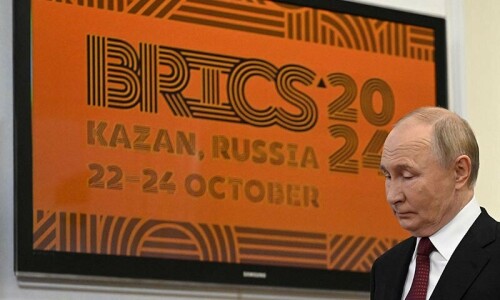
Chinese President Xi Jinping reiterated in Kazan, where the BRICS [Brazil, Russia, India, China and South Africa] Summit is being held, that Russia and China “intend to further enhance coordination on all multilateral forums in order to ensure global security and a just world order”. He said their strategic partnership was a force for stability amid the most significant changes seen in a century.
Western observers say China represents 60 per cent of the group’s economic output, which allows Beijing to pledge more investments and loans to other members. China, being the largest economy in Britain, is a magnet. Both Kremlin and Beijing have pushed proposals to drastically change the global financial system.
In view of the global South, economic and financial sanctions have undermined the sovereignty of countries and disrupted global economic relations. Moreover, protectionist actions and trade restrictions undermine the multilateral trading system and impede global sustainable development.
The US has dismissed the idea that the organisation could become a ‘geopolitical rival’ but has expressed concern about Moscow flexing its diplomatic muscle as the Ukraine conflict rages
The sanctions have stifled free trade, and as pointed out by analyst Aqdas Afzal, global economic thinking (particularly in developed economies of the West) has shifted from free trade to strategic trade, where state power now shapes competitive advantage. Countries adversely affected are now struggling to overcome the challenges facing them.
The United States has dismissed the idea that the organisation could become a ‘geopolitical rival’ but has expressed concern about Moscow flexing its diplomatic muscle as the Ukraine conflict rages. “I would take BRICS seriously when I see signs that the two countries that matter, China and India, are actually, really trying to agree on things, rather than trying to confront each other all the time,” says former Goldman Sachs economist Jim O’Neill.
The main issue on the summit agenda included President Vladimir Putin’s idea for a BRICS-led payment system to rival Swift, an international financial network that Russian banks were cut off from in 2022, as well as the escalating conflict in the Middle East. The final communiqué listed a number of other projects aimed at facilitating trade between BRICS nations but media reports said it did not include details or timelines.
Mr Putin said the members were working on a Swift-like financial messaging system immune to Western sanctions. He also claimed that in the last decade, over 40pc of the GDP growth of the entire world dynamics came from member countries. “What BRICS is doing is gradually — brick by brick — building a bridge to a more democratic and just world order.”
Mr Putin asserted that the economic growth of BRICS members will increasingly depend less on external influence or interference. “This is essentially economic sovereignty.”
Earlier, in a move aimed at reducing reliance on the US dollar and other foreign currencies, the Shanghai Cooperation Organisation (SCO) called for prioritising the use of national currencies in mutual settlements.
Some SCO members, including Pakistan, have entered bilateral currency swap agreements, which enable them to trade directly in their local currencies.
The State Bank of Pakistan says the country has achieved a key milestone by enabling payments in rupees between Pakistan and Arab countries through the integration of Raast, the instant payment system, with the Arab Monetary Fund’s Buna platform.
The SCO Summit also decided to expedite consultations on the establishment of financial institutions, which are expected to contribute to economic integration, trade facilitation, and regional connectivity. They include the SCO Development Bank, the SCO Development Fund and the SCO Investment Fund.
The Shanghai spirit ensures that every member state has an equal voice regardless of economic size, military strength, or international influence and that serves as a model for multilateral cooperation, says Russian political scientist Evgenia Makhmutova.
Published in Dawn, The Business and Finance Weekly, October 28th, 2024