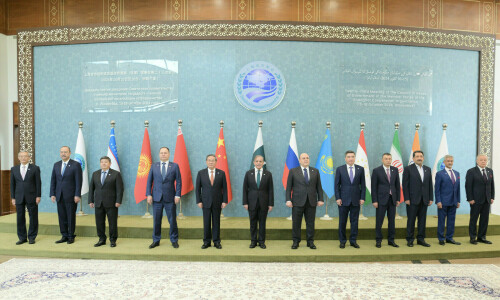
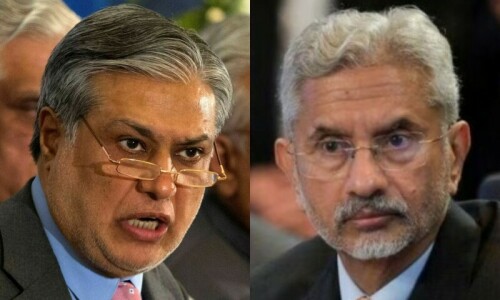
WHILE there was no bilateral breakthrough during Indian External Affairs Minister S. Jaishankar’s visit to Islamabad for the SCO summit — and none was expected — the most positive takeaway was that the usual hostility that has marked Pakistan-India ties over the past several years was replaced with courteous exchanges.
Though Mr Jaishankar did indulge in the usual Indian rhetoric of ‘cross-border terrorism’, there was no direct reference to Pakistan, and his words were couched in diplomatese. It has not gone unnoticed that while the format required SCO heads of government to attend, Indian Prime Minister Narendra Modi stayed away, preferring to send his top diplomat instead. Yet considering the state of bilateral ties, India could have skipped the moot entirely. Therefore, even limited bilateral engagement, under the umbrella of multilateralism, is welcome.
Mr Jaishankar exchanged handshakes and pleasantries with the prime minister and his Pakistani counterpart, while thanking the government for its “hospitality and courtesies”. This is certainly an improvement over last year, when Bilawal Bhutto-Zardari received a highly uncordial reception at the SCO foreign ministers’ meeting in Goa.
Perhaps the SCO — with the heft of China and Russia behind it — is working better as a platform for bringing together regional states than groupings such as the moribund Saarc. The reason for this is largely India’s refusal to engage with Pakistan even under the aegis of Saarc. But possibly the thinking is changing in New Delhi, while it might also be true that the Indians do not want to annoy Beijing and Moscow by appearing to sabotage the SCO.
The Indian foreign minister, in his comments in Islamabad, mentioned “terrorism” and “separatism” as obstacles standing in the way of “friendship … and good neighbourliness”. This is, of course, the standard Indian line. However, Pakistan also has legitimate concerns vis-à-vis India, which include the Kashmir question, the treatment of Muslims in India, and the activities of subversive elements on Pakistani soil with the apparent support of New Delhi.
The joint communiqué issued after the SCO summit reaffirmed the participants’ “commitment to the peaceful settlement of differences … through dialogue”. This is the key to peace in the subcontinent. Dialogue should be uninterruptible and should cover all sticking points standing in the way of better ties. While India’s hawks may dismiss the need to talk to Pakistan, dreams of regional integration — especially if Delhi wants to reach Eurasian markets — will remain unfulfilled by not talking. Similarly, hardliners in Pakistan should realise that better ties with India can have economic advantages for this country.
There are reports that the resumption of cricketing ties was discussed during Mr Jaishankar’s visit. While India has denied this, better sporting ties and restoration of the respective high commissioners, can be the starting point on the long road to normalisation.
Published in Dawn, October 18th, 2024