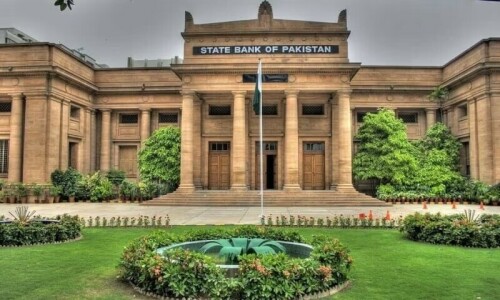
Structural impediments are challenges to sustaining macroeconomic stability, the State Bank of Pakistan (SBP)’s annual report on the state of the economy said on Thursday.
“Falling investment … unfavourable business environment, lack of research and development, and low productivity, alongside climate change risks continue to constrain the economy’s growth potential,” the SBP said in a statement.
Additionally, the central bank noted that “longstanding inefficiencies in the energy sector have resulted in the accumulation of the circular debt”.
“While the government has started to address energy sector challenges through substantial price adjustments, there is a need to broaden the scope of these efforts by introducing sectoral policy and regulatory reforms,” it said.
The SBP added that the reforms were necessary to address the inefficient nature of state-owned enterprises (SOEs) that continued to burden fiscal resources already restrained by a low tax-to-GDP ratio.
On a positive note, the report noted improved macroeconomic conditions on the back of the International Monetary Fund (IMF) Extended Fund Facility (EFF), which was approved by the Fund’s Board in September.
The SBP said that the IMF programme “is anticipated to further strengthen the country’s external account position, improve sovereign credit rating and enhance investor confidence”.
“At the same time, the country is expected to benefit from a conducive global economic environment,” it said, highlighting that inflation was falling in advanced economies while global economic growth was expected to remain steady.
The report stated that “recent outturns” suggested the average inflation to fall below the earlier projected range of 11.5 to 13.5 per cent for FY25.
Finance minister reiterates govt’s resolve for reforms

Meanwhile, Finance Minister Muhammad Aurangzeb reiterated the government’s resolve to carry on with broad-based reforms on taxation, energy and SOEs in a meeting with US Ambassador Donald Blome.
The finance minister underscored that the government was committed to raising the country’s tax-to-GDP ratio to 13.5pc in the next three years by plugging leakages and bringing untaxed sectors into the tax net.
Appreciating the government’s effort to improve macroeconomic stability, the ambassador underlined the US’ commitment to enhancing bilateral cooperation in technical and development initiatives and promoting high-quality US investment in Pakistan.