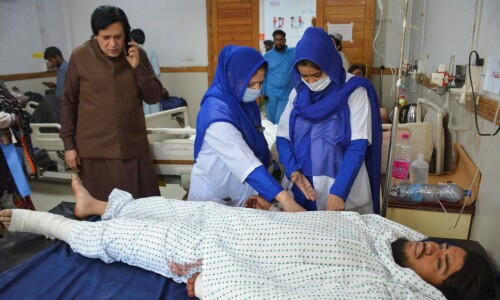
WHILE visiting survivors of last week’s heinous attack on coalminers in Duki, Balochistan Chief Minister Sarfaraz Bugti said on Saturday that a military operation was not on the cards in the troubled province. He added that intelligence-based operations were “ongoing” to uncover the facts behind the atrocity.
Though a variety of militant groups are active in Balochistan, till date no one has claimed responsibility for the Duki massacre. While there is surely a need to neutralise violent elements that present a danger to public safety in the province, the fact is that militarised responses to terrorism and insurgency have been tried in Balochistan for decades, but have failed to bring permanent peace to this tortured land.
Therefore, there is a need to investigate the intelligence lapses that led to the Duki terrorist attack and earlier violent episodes, while kinetic responses can only work if there are complementary political and economic efforts to address the deprivation that fuels separatist sentiment.
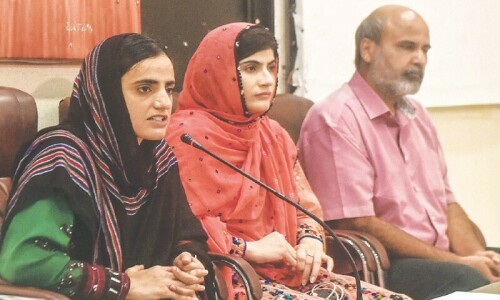
However, it appears the state is determined to continue using the same old playbook against voices peacefully demanding their rights in Balochistan. In this respect, a terrorism and sedition case has been filed against rights activist Dr Mahrang Baloch for her alleged “anti-state campaign”. Perplexingly, the case has been filed by a businessman from Karachi’s Landhi area.
Unfortunately, these tactics are not new. Whenever elements within the state want to tar someone with the ‘anti-national’ brush, cases are filed by random individuals in far-flung cities with no connection to the activists or their cause. In some instances, the activism has ‘hurt’ the feelings of the random aggrieved parties, and they have dutifully filed cases based on extremely serious charges. Dr Baloch has termed the case “fabricated” and has vowed to “fight this in a court of law”.
The sad truth is that when the powers that be marginalise and defame peaceful voices calling for change and rights, then disaffected populations are pushed towards radicalisation and confrontation with the state. The recently concluded jirga in Jamrud, organised by the proscribed PTM, raised many of the same points that Baloch activists have been highlighting for years. It includes the problem of enforced disappearances and the extraction of KP’s resources, with few benefits reaching the common people from this natural wealth.
In order to stem the tide of disaffection, efforts to maintain law and order have to be supported by political initiatives that allow deprived segments of the population to freely air their grievances, with appropriate responses from the state. Pakistan can only move forward when disillusioned segments of society — particularly in Balochistan and KP — are brought into the mainstream, and are given their constitutional rights. In the long term, this can be amongst the most effective counterterrorism measures.
Published in Dawn, October 15th, 2024