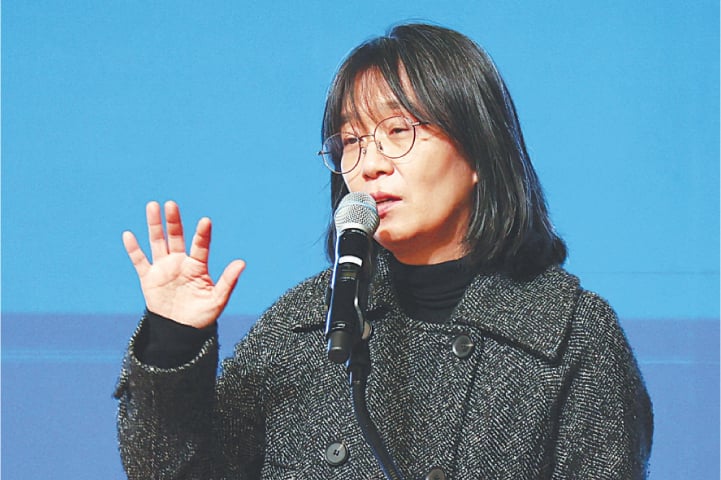
STOCKHOLM: Author Han Kang on Thursday became the first South Korean to win the Nobel Prize in Literature for her work exploring the correspondence between mental and physical torment as well as historical events.
A short story writer and novelist, Han is best known for her book The Vegetarian, which was her major international breakthrough and won the Man Booker Prize in 2016.
The 53-year-old was honoured with the Nobel “for her intense poetic prose that confronts historical traumas and exposes the fragility of human life,” the Swedish Academy said.
She is one of only 18 women, and the first from Asia, to receive the literature Nobel out of 121 laureates — though the Academy has made strides in that regard, crowning nine women in the past two decades.
Her Nobel dominated headlines in South Korea, with Han’s photo appearing on the front pages of news websites and headlines hailing her historic win. “She has shown K-literature to the world,” South Korean daily Munhwa Ilbo wrote.
The newspaper asked: “Is this the start of K-novels?” referring to the so-called Korean wave, which has seen the country’s K-pop music and K-drama television programming sweep global charts.
The Academy has long been criticised for the overrepresentation of Western white men authors among its picks.
Han had just finished dinner with her son at her home in Seoul when she got the news in a call, she told a Nobel Foundation interview. “I’m so surprised and absolutely honoured,” she said. “I grew up with Korean literature, (to) which I feel very close. So I hope this news is nice for Korean literature readers and my friends, writers and others.”
‘Rich and complex’
In addition to her writing, Han is also a musician and artist, which is reflected in her literary works. The daughter of novelist Han Seung-won, she began her career in 1993 by publishing several poems, followed two years later by the short story collection “Love of Yeosu”.
Her 2002 novel “Your Cold Hands” reproduces a manuscript left behind by a missing sculptor obsessed with making plaster casts of female bodies, and reflects Han’s interest in art.
The Academy described Han’s 2010 book “The Wind Blows, Go” as a “complex novel about friendship and artistry, in which grief and a longing for transformation are strongly present”.
In 2014, she published the novel “Human Acts”, inspired by a massacre carried out by the South Korean military in 1980 and deals with the death of a young boy amid the democratic uprising.
Two years later, she published “The White Book”, an elegy to her older sister who passed away hours after being born. It is described by many, including the Academy, as a kind of “secular prayer book”.
One of her more recent books, “We Do Not Part” from 2021, is closely connected to “The White Book” in terms of its imagery of pain, the Academy noted.
Blacklisted over criticism
During the presidency of Park Geun-hye from 2013-2017, she was among more than 9,000 artists blacklisted for their criticism of Park’s government.
The artists had voiced support for liberal opposition parties, or criticised Park’s conservative government and its policy failures, including the botched rescue efforts after the 2014 Sewol ferry sinking in which around 300 people died.
Published in Dawn, October 11th, 2024