Sri Lanka’s new President Dissanayake promises change



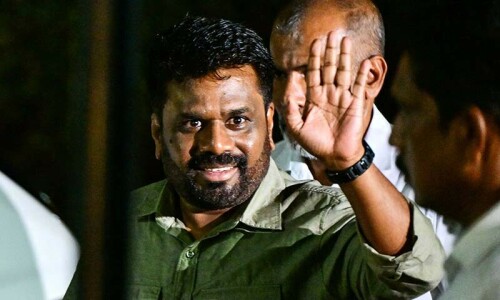
Sri Lanka’s leftist leader Anura Kumara Dissanayake took office as president on Monday, promising change in the island nation long led by powerful political families which is emerging from its worst economic crisis in more than seven decades.
Millions of Sri Lankans had voted for the opposition parliamentarian, putting faith in his graft-fighting pledge and vow to bolster a fragile economic recovery.
“I pledge … to demonstrate dedication to protecting and upholding democracy,” Dissanayake, 55, said in inauguration remarks at the president’s office, saying he was taking office at a challenging time in the Indian Ocean nation.
“Our politics needs to be cleaner, and the people have called for a different political culture,” he added. “I am ready to commit to that change.”
Dissanayake ran as the candidate for the National People’s Power (NPP) alliance, which includes his Janatha Vimukhti Peremuna (JVP) party that traditionally championed Marxist economic policies centred on protectionism and state intervention.
In recent years the party has taken more centrist positions.
Outside, dozens of supporters held up posters carrying his image, with some waving the Sri Lankan flag and chanting “AKD”, the initials of the new president, who displaces the incumbent, veteran politician Ranil Wickremesinghe.
“I’m very happy,” said one of them, beautician Iroma Nilanthi Liyanage, adding that Dissanayake inspired supporters with hope. “We worked very hard for this victory. For the first time, the poor people have someone who stands for them.”
Tasks he now faces include setting up a new cabinet and wooing parliament, where his party has just three of 225 seats, to pass a budget under the terms of a $2.9 billion bailout from the International Monetary Fund (IMF).
Debt deal finalised last week
This was Sri Lanka’s first election since its economy buckled in 2022 under a severe foreign exchange shortage, leaving it unable to pay for imports of essentials, including fuel, medicine and cooking gas. Protests forced then-president Gotabaya Rajapaksa to flee and later resign.
Before Monday’s swearing-in, Prime Minister Dinesh Gunawardena resigned to make way for a new prime minister and cabinet.
Gunawardena, 75, took over as prime minister in July 2022 after Rajapaksa fled and resigned amid protests unleashed by the crisis, which also triggered a debt default.
Dissanayake was declared the new president late on Sunday, displacing Wickremesinghe, who had been appointed by parliament to serve out Rajapaksa’s remaining term.
Popularly known as AKD, Dissanayake polled 1.27 million votes more than his nearest rival and main opposition leader Sajith Premadasa. Wickremesinghe finished third.
Sri Lanka’s sovereign dollar bonds shed 2.88 to 3.28 cents on the dollar in early trade on Monday to bid between 49.14 and 49.77 cents.
Investors worry that Marxist-leaning Dissanayake’s desire to revisit the terms of the country’s IMF bailout could delay future disbursements and that he could seek to renegotiate a debt deal with bondholders finalised last week.
Sri Lanka’s close neighbours India, Pakistan and the Maldives also congratulated Dissanayake on his win, along with China, the largest bilateral creditor.
“China hopes that Sri Lanka will maintain its national stability and development, and is willing to play a constructive role in the smooth economic and social development,” a Chinese foreign ministry spokesperson said on Monday.
The spokesperson declined to give details of the prospect of Sri Lanka wanting to revisit debt agreements it struck with Beijing but said China hoped to deepen high-quality development in the construction of the Belt and Road together.