0
0

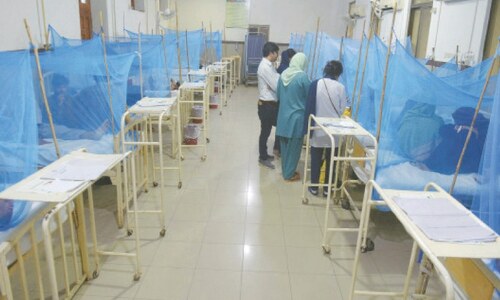
ISLAMABAD: As dengue cases register a consistent spike in the aftermath of monsoon rain spells, the twin cities on Saturday reported 22 cases — eight in Islamabad and 14 in Rawalpindi — amid warnings by the health authorities that these cases would continue to rise in the absence of compliance with anti-dengue guidelines and negligence in surveillance.
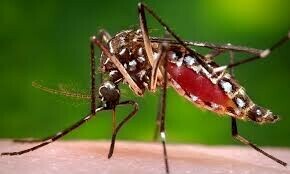
The number of dengue cases in the federal capital has risen to 93 following which the Ministry of National Health Services (NHS) doubled its surveillance teams and urged masses to play their role in the eradication of dengue mosquitoes.
“We have been doing all possible arrangements at our end so that cases would not increase but our efforts can never bear fruits without the cooperation of the people,” Health Secretary Nadeem Mehbub said.
“In the majority of cases, people need to play a role because breeding grounds of dengue larvae are mostly established in houses, under-construction buildings, shops and other places where teams of the District Health Office may not reach… We request masses to ensure that there would be no stagnant water in any place within the house,” he added.
Secretary says 500 additional workers hired to boost surveillance in Islamabad
Mr Mehbub said as many as 500 more workers had been hired to do surveillance till the end of the dengue season.
“They will also eradicate the dengue larvae and hotspots. Over 200 lady health workers have been visiting door to door to give awareness to people that how hot spots are eradicated,” he said.
Nadeem Mehbub said that during the current season, 93 cases of dengue had been reported from Islamabad, out of which 68 surfaced from the rural areas and 25 from urban areas. He claimed that the ministry had been monitoring the situation on a daily basis as the city reported eight new cases on Saturday.
In Islamabad dengue season usually starts in March and ends in November. Pakistan has experienced many outbreaks of dengue since 1994, with major outbreaks reported in 2005, 2011 and 2019. Around 6,000 cases of dengue with 52 deaths were reported from Karachi in 2005; over 21,000 cases with 350 deaths were reported from Lahore in 2011 and around 50,000 cases with 79 deaths were reported in 2019 from across the country.
Rawalpindi
As many as 14 dengue patients arrived in the three government-run hospitals on Saturday as the District Health Authority took disciplinary action against 250 sanitary patrols found absent from their duties.
Talking to Dawn, District Health Authority Chief Executive Officer Dr Asif Arbab Niazi said during the third party validation campaign of different union councils, “we found as many as 250 sanitary patrols constantly absent from duty without informing the office, following which their salaries were deducted.
He said it was necessary for the anti-dengue teams to complete the spray and detect dengue larvae in their respective areas. He said these months were critical which was why an aggressive campaign had been started.
Taking notice of the rise in dengue cases, the District Health Authority issued warning and urged the people to be alert, take precautionary measures, realise their individual responsibilities and take a serious attitude towardsdenguecontrol because if the current trend of denguecases continued, by mid-September, cases would rise considerably.
Dr Niazi said the number ofdenguepatients had increased in Rawalpindi in the current week.
Till last week, five to six patients were being reported daily but now the number has increased from 10 to 12, he said.
As many as five patients arrived in Holy Family Hospital, 10 were admitted to District Headquarters Hospital and 13 patients were brought to Benazir Bhutto Hospital. The patients came from Girja, Kahuta, Dhoke Chaudhrian, Chaklala Scheme-III, Banni Chowk, Gulraiz Colony, Gulistan Colony, Band Khana Road,
Tench Bhatta, Dhoke Munshi and adjoining areas.
Published in Dawn, September 8th, 2024