US open to escorting Philippine ships in South China Sea


MANILA: US ships could escort Philippine vessels on resupply missions in the South China Sea, a top admiral said on Tuesday, describing what he called an “entirely reasonable option” that required consultation between the treaty allies, however.
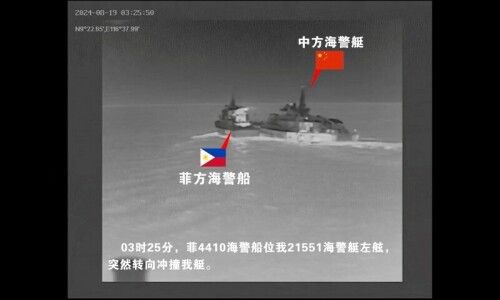
The remarks, which are likely to annoy China, were made by Samuel Paparo, commander of the US Indo-Pacific Command, after a series of maritime and air confrontations between the Philippines and China in the South China Sea in the past week.
Beijing has pressed its claim to the disputed conduit for more than $3 trillion of annual ship-borne commerce, while Manila has kept up supply missions, particularly those to a beached naval ship on the hotly contested Second Thomas Shoal.
“Escort of one vessel to the other is an entirely reasonable option within our Mutual Defence Treaty,” Paparo told reporters on the sidelines of a military forum organised by the Indo-Pacific Command.
He was responding to a query whether Washington would consider providing escorts to ships from the Philippines taking supplies to disputed geographical features in the waterway. “I mean certainly, within the context of consultations,” Paparo added, without giving details of ships likely to be employed for the task.
Washington is bound by a 1951 treaty to defend the Philippines in case of armed attacks on its forces
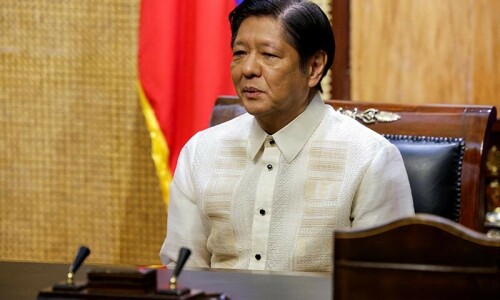
Philippine military chief Romeo Brawner said the southeast Asian nation preferred to run those missions on its own, however, making every effort to ensure their success despite what Manila calls China’s “dangerous” and “coercive” actions.
“We are going to try all options, all avenues that are available to us,” Brawner told reporters. “While we can do it by ourselves, we will do it.” But the Philippines would seek alternatives if it found itself constrained from doing so, he added.
“It’s not just perhaps operating with the United States, but also with other like-minded nations.” Washington is bound by a Mutual Defence Treaty dating from 1951 to defend the Philippines in case of armed attacks on its forces, public vessels, or aircraft in the South China Sea.
That treaty must be interpreted more broadly to tackle a “dynamic and cunning adversary”, Philippine Defence Secretary Gilberto Teodoro told reporters, although it has already proved a “great deterrent” in the South China Sea.
In recent years, the Philippines has complained of China’s use of so-called grey-zone tactics, or coercive actions that are just shy of armed conflict. But China has maintained its actions were professional and lawful. Teodoro also urged regional nations to call out China, which he described as the “biggest disruptor of peace”, for its activities in the waterway.
Published in Dawn, August 28th, 2024