BEIRUT: At least 27 people, including two children, were killed in Israeli air strikes, with around 10 fatalities in Nabatieh, south Lebanon, and at least 17 in the Gaza town of Zawayda, according to health officials.
The 10 victims of Israeli airstrike in south Lebanon were all Syrian citizens, state news agency NNA said, adding that a final toll of the strike would be announced after DNA tests were conducted to determine the identity of the victims.
The Israeli military said the airstrike targeted a weapons depot used by Hezbollah fighters.
The Israeli strike came after ceasefire talks between Palestinian Islamist group Hamas and Israel in Doha paused on Friday with negotiators due to meet again next week.
Tel Aviv issues new evacuation orders in Palestinian enclave
Hezbollah later said in a statement that it had struck the Ayelet Hashahar Kibbutz in northern Israel in retaliation for the Nabatieh strike.
Two soldiers were wounded in a rocket attack from Lebanon, the Israeli military said, adding that a total of 55 rockets had been fired in latest strikes from Lebanon.
Also on Saturday, an Israeli drone targeted a motorcycle in the Qadmous area east of Tyre in south Lebanon, NNA reported, adding that one person was injured. A security source said one person was killed in the motorcycle attack.
Tensions have soared in the region in recent weeks, after a rocket strike blamed on Hezbollah killed 12 children and teens in the Israeli-occupied Golan Heights.
Israel responded with the killing of a top Hezbollah commander in the suburbs of Beirut.
Killings in Gaza
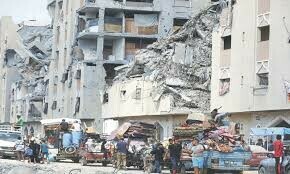
At least 17 Palestinians were killed and dozens wounded in the Israeli strike in the Gaza town of Zawayda on Saturday, health officials said, as Israel issued new evacuation orders, citing Hamas rocket fire nearby.
Most of the people killed were from the same family and they included eight children and four women, according to health officials.
Israel’s military said it was aware of the reports of the strike and was looking into them.
“They were asleep in their beds, kids and babies, then three missiles targeted their place,” said Abu Ahmed Hassan, a neighbour. The owner of the house was a known merchant, he said. “There are no military activities here at all,” he added.
Israel’s military spokesperson in Arabic posted instructions on X on Saturday for people in parts of central Gaza, including in Maghazi district which is near Zawayda, to evacuate to a designated humanitarian zone.
He said militants were firing rockets from those locations and that the military was preparing to act against them.
Reuters could not immediately verify whether any areas of Zawayda were among those ordered to evacuate and whether people there received the military’s instructions. Residents said thousands were streaming out of Maghazi.
On Friday, two sections of the southern city of Khan Younis within what Israel has designated as a humanitarian zone were deemed dangerous by the military, which ordered people to evacuate them saying that militants had been regularly firing rockets from there.
The United Nations Office for the Coordination of Humanitarian Affairs (OCHA) said Friday’s orders, which also included other areas of the enclave outside the humanitarian zones, had affected around 170,000 displaced people.
“This is one of the largest evacuation orders affecting the zone to date and it shrinks the size of the so-called ‘humanitarian area’ to about 41 square kilometres, or 11 per cent of the total area of the Gaza Strip,” an OCHA report said.
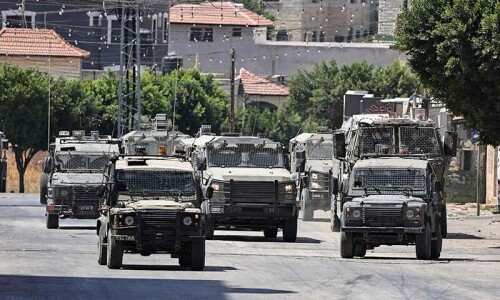
In the central part of the enclave, residents said that Israeli tanks advanced further on Saturday into the eastern area of Deir Al-Balah, an area they had not invaded before, where hundreds of thousands of displaced Palestinians are sheltering.
Most of Gaza’s 2.3 million population has been displaced by the 10-month-old Israeli offensive, which has laid waste to much of the enclave.
Published in Dawn, August 18th, 2024