Taiwan’s Lin beats Uzbek Turdibekova amid fierce gender row


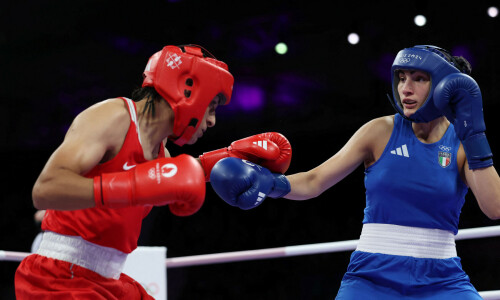
PARIS: Taiwan’s double world champion Lin Yu-ting, one of two boxers at the heart of a gender row, won her featherweight round of 16 bout against Uzbekistan’s Sidora Turdibekova on points by unanimous decision at the Paris Olympics on Friday.
The 28-year-old Taiwanese, along with Algerian boxer Imane Khelif who won her round of 16 welterweight fight on Thursday against Italy’s Angela Carini in 46 seconds, have been in the spotlight of the row after being cleared to compete in the Olympics.
Both were disqualified at the 2023 World Championships after failing International Boxing Association eligibility rules that prevent athletes with male XY chromosomes from competing in women’s events.
The boxing competition in Paris is run by the International Olympic Committee (IOC) after it removed the IBA’s international recognition in 2023 over governance and finance issues. The IOC has said the women have every right to compete in Paris.
Some sports have limited the levels of testosterone allowed for athletes competing in women’s competition, while others ban everyone who has been through male puberty.
Differences of Sexual Disorder (DSD) are a group of rare conditions involving genes, hormones and reproductive organs. Some people with DSDs are raised as female but have XY sex chromosomes and blood testosterone levels in the male range.
The IOC said the IBA decision to disqualify the boxers last year was arbitrary and the main cause for the furore that has seen people like J. K. Rowling and Elon Musk voice their opposition to them competing in the Games.
Following Khelif’s quick win on Thursday that had drawn the ire of Italian Primer Minister Giorgia Meloni, who said it was not a fight among equals given the Algerian’s physical advantage, hundreds of media had gathered for Lin’s fight.
But the Uzbek was not prepared to be easy prey to her opponent, only narrowly losing the first round and with one of the judges even scoring the round in her favour.
The taller Lin, however, was never really threatened and landed a big right in the second round that rattled Turdibekova.
With chants of “Uzbekistan” echoing through the North Paris Arena the Uzbek fighter tried to come back in the third but it was Lin who had the upper hand and got her opening win at the Games. Both fighters refused to talk to the press following their bout with the Uzbek going past reporters in tears.
But Lin’s coach Tseng Tsu Chiang paused briefly. “This is how the sport is. We respect the ruling and all the rules,” he said adding that Lin “was a little nervous in her first bout. Anyway, we just enjoyed the contest.”
Lin next faces Svetlana Kamenova Staneva of Bulgaria in the quarter-finals.
“With the situation in this category, which, you know, people are talking about all over the Facebook, the internet and media, this is not good for women’s boxing,” Staneva told reporters.
The IOC has said the rules of eligibility are based on those of the Tokyo Games in 2021 and cannot be changed during a competition. It has also called for the creation of a new international body that would then decide on eligibility criteria.
Both Khelif and Lin fought at the 2021 Tokyo Olympics without controversy or success — both lost in the round of 16. They were then disqualified from the 2023 World Championships in New Delhi run by the IBA.
Tunisian coach Samir Khlifi, speaking after his boxer Khouloud Hlimi lost in a later bout in Lin’s class, called the IBA decision to ban Khelif “political”.
“I’ve known that boxer for a long time,” he said of the Algerian. “I knew her when she was a girl and now there is a question mark. The International Olympic Committee did her justice and allowed her to participate. I hope she goes right to the end and wins a medal for the Arab world.”
After Khelif’s victory started the controversy, the IBA took an opportunity to punch back.
It said in a statement the athletes “did not undergo a testosterone examination but were subject to a separate and recognised test”. However the “specifics” of this test “remain confidential”, the IBA said.
IOC spokesman Mark Adams said the Olympic body’s eligibility criteria was based on the gender indicated on the boxers’ passports, but acknowledged the issue was not “black and white”.
Published in Dawn, August 3rd, 2024