Pakistan’s strategic position offers distinct economic benefits, with a 290,000 square kilometre exclusive economic zone and an approximate 1,001km coastline. In the context of the blue economy, a comprehensive range of sectors such as fisheries, aquaculture, renewable energy, shipping, shipbreaking, offshore minerals, tourism, etc., are included.
Pakistan has significant unexploited marine resources that, if properly harnessed, can attract substantial foreign direct investment (FDI). Pakistan’s immense marine resources and strategic location offer substantial potential for economic growth through the blue economy.
The Pakistan Economic Survey 2023–2024 shows growth equivalent to 2.4 per cent of GDP. As per the survey, the agriculture sector registered a progress of 6.25pc, highlighting a significant achievement for food security and price stability.
Investing in marine resources, seaport infrastructure, and sea trade can drive significant economic growth. Total fish production reached 791 million metric tonnes in 2024 (July–April). Pakistan’s major fish buyers during July-March FY24 included China, Japan, Malaysia, the Middle East, Thailand, and Sri Lanka, earning approximately $534m in fishing, with a growth rate of 0.81pc and contributing 0.31pc to GDP.
Compared with its regional peers, Pakistan’s port infrastructure requires significant upgrades to match the efficiency and capacity witnessed in ports at Singapore and Dubai
To fully realise the potential of the blue economy, Pakistan should focus on improving infrastructure, enhancing value-added processing, and expanding market access. Investing in sustainable practices and technology also ensures long-term growth and environmental conservation.
During this year’s budget session, the federal finance minister highlighted the special emphasis on the blue economy and the importance of sea transport for sustainable export and import. The government has prioritised the blue economy sector, allocating Rs24.6 billion for agriculture, food, irrigation, forestry, and fishing in the current year’s budget.
The finance ministry also awarded the Ministry of Maritime Affairs technical supplementary grants worth Rs429m for development projects in Gwadar. The Punjab government has allocated a budget of Rs9.7bn for aquaculture, forestry, and wildlife, while the Sindh government has allocated Rs8.1bn for livestock and fisheries. The Balochistan government is also readily investing in aquaculture worth Rs5m.
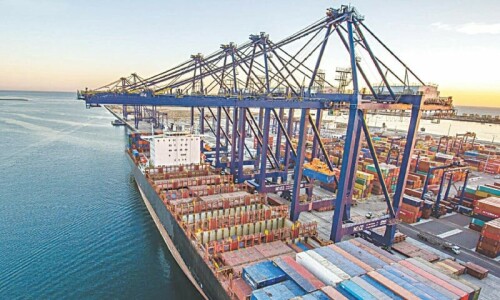
On the other hand, the significance of ports can never be undermined. Among the three major ports — Karachi, Gwadar, and Port Qasim Authority (PQA) — Karachi Port Trust (KPT) has been playing a crucial role in maritime traffic and cargo handling at the seaport.
The cargo and container handling at Karachi Port during the end of FY24 was 51.65m tonnes, compared to 41.85m tonnes during FY23, while the import/export breakdown shows imports of about 32.85m tonnes and exports of 12.78m tonnes (as per a KPT press release).
PQA, during the first nine months of FY24, handled 34.3m tonnes of cargo — 10 more cargo than last year in 2023, according to a survey. To sustain this growth, Pakistan should prioritise investing in expanding port infrastructure and streamlining custom processes to further enhance trade efficiency and capacity.
Gwadar Port’s existence is pivotal for socioeconomic development and Chinese investment in the Port is a golden opportunity for Pakistan. Balochistan’s marine resources, coastal areas, and beaches have the potential to build tourism infrastructure with the help of China. We need to stimulate investment in the province’s tourism sector.
The government must improve port infrastructure and adhere to international laws and standards. Investments in technological advancement, infrastructure, logistics, and human resources are essential to attract FDI. Compared with its regional peers, Pakistan’s port infrastructure requires significant upgrades to match the efficiency and capacity witnessed in ports in Singapore and Dubai.
The China-Pakistan Economic Corridor project can promote maritime trade and regional connectivity. Beautiful coastal destinations can attract local and international tourists if effective measures for infrastructure development, security, basic amenities, and transportation are taken.
Furthermore, the economic survey elaborates on transportation by sea. The Pakistan National Shipping Corporation (PNSC) is also playing a key role. The financial performance of PNSC for July-March FY24 shows the following statistics: revenue at Rs35m, operating profit at Rs17.5m, profit before tax at Rs16.8m.
PNSC is engaged in various operations with its 12 vessels, comprising five bulk carriers and seven oil tankers. The shipping corporation has a huge capacity to excel at its potential in container business and transportation.
In sum, the blue sector is crucial for improving Pakistan’s economy. The Small and Medium Enterprises Development Authority prioritises the blue economy by providing loans to blue sector-related businesses. Governmental efforts for economic growth are also showing steady though slow progress.
Looking forward, sustainable economic development will become an essential component of every sector, for which blue resources can easily provide for the country’s progress. It is high time for Pakistan to capture and shift investments in the marine sector to take advantage of its potential.
The writer is a researcher at the National Institute of Maritime Affairs, Islamabad
Published in Dawn, The Business and Finance Weekly, July 22nd, 2024