Roman marble statue found in ancient Bulgarian sewer



PETRICH: An exceptional white marble statue from Roman times was recovered from the sewer ruins of an ancient city in southwestern Bulgaria on Friday.
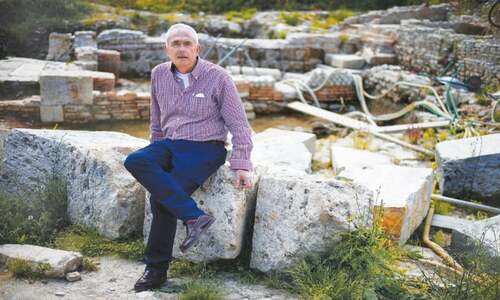
The 2.1-metre tall statue, likely dating from the second century AD, is missing an arm but has a perfectly preserved head, a rarity for Roman statues and a unique find for Bulgaria, archaeological excavations chief Lyudmil Vagalinski said.
“Such Roman copies of ancient Greek models can be seen in Athens and northern Greece, as well as in the Louvre museum, but they are rare,” he said, also noting its “very high quality” as a work of art.
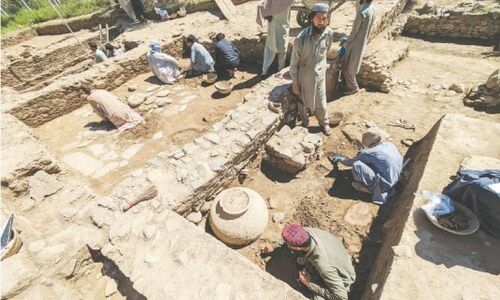
Archaeologists stumbled upon the unexpected find last week in the ancient Roman town of Heraclea Sintica while digging in the Cloaca Maxima, the city’s tunnel-shaped urban sewage canal.
They first came upon a foot before the whole statue — lying on its left side facing the wall — emerged little by little as they kept digging.
The sculpture, which archaeologists think depicts a king with a slender profile and divine traits, was spared from strong earthquakes in the fourth century AD and from floods by a covering of earth.
“This was the period when Christianity was forcing its way into the Roman Empire. The statue, a symbol of pagan times, was therefore carefully hidden,” Vagalinski explained.
The statue’s height “was intended to demonstrate the superiority of God over mankind”, he added.
A week after the surprising discovery, archaeologists proceeded with the statue’s meticulous excavation.
Its most fragile parts — the neck and the ankles — were covered in protective foam to prevent them from breaking when the one-tonne figure was lifted upright from the ground.
It was placed in a wooden box for transportation to the museum in the nearby town of Petrich, where experts will study and restore it before putting it on display for the public.
Published in Dawn, July 13th, 2024