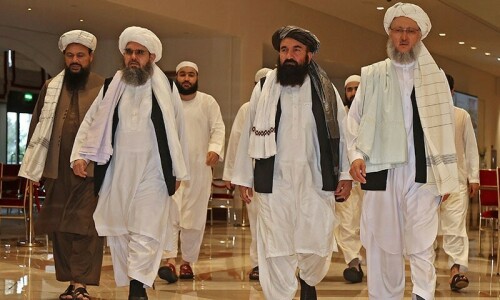
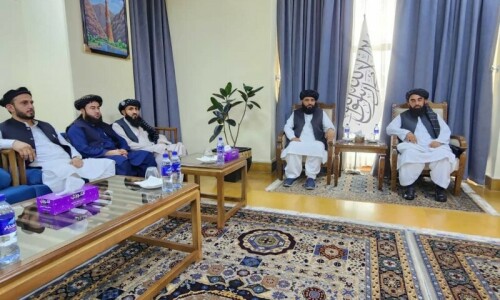
DOHA: Afghan Taliban representatives said on Monday they would press the international community over economic sanctions, even as international envoys raised concerns about restrictions on women and girls in Afghanistan during meetings with the country’s rulers.
A Taliban delegation is attending the UN-hosted summit in Doha with special representatives to Afghanistan, for the first time.
The two-day meeting, which began on Sunday, is the third such summit to be held in Qatar in a little over a year.
The talks on Monday looked at the private sector and narcotics in particular. “There was broad agreement on the need to chart a clear way forward,” United Nations’ political affairs chief Rosemary DiCarlo said.
Talks focus on private sector, narcotics control; Taliban envoy stresses need for constructive engagement with West
Writing on X, formerly Twitter, senior foreign ministry official Zakir Jalaly said the Taliban government delegation would use Monday’s meetings to address “financial and banking sanctions” and the “challenges” these pose to Afghanistan’s economy.
His statement followed an opening salvo late Sunday by the head of the Taliban delegation, spokesman Zabihullah Mujahid, as he addressed more than 20 envoys and UN officials.
The talks are being held to discuss increasing engagement with the impoverished country of more than 40 million and a more coordinated response, including economic issues and counter-narcotics efforts.
“Afghans are asking why they are being ganged up on, on the basis of unilateral and multilateral sanctions,” Mujahid said as he questioned whether ongoing sanctions were “fair practice” after “wars and insecurity for almost half a century as a result of foreign invasions and interference”.
Mujahid said diplomats should “find ways of interaction and understanding rather than confrontation”, despite “natural” differences in policy.
“The Islamic Emirate of Afghanistan is keen on engaging constructively with Western nations as well,” Mujahid said.
“Like any sovereign state, we uphold certain religious and cultural values and public aspirations that must be acknowledged.”
But according to Ms DiCarlo: “Running through all the discussions was the deep international concern — from special envoys and from me — about the ongoing and serious restrictions on women and girls.”
“Afghanistan cannot return to the international fold, or fully develop economically and socially, if it is deprived of the contributions and potential of half its population,” she added.
Since the Taliban’s return to power, most girls have been barred from high school and women from universities.
The Taliban have also stopped most Afghan female staff from working at aid agencies, closed beauty salons, barred women from parks and curtailed travel for women in the absence of a male guardian. Rights groups have criticised the UN for not having Afghan women at the table with the Taliban in Doha.
Published in Dawn, July 2nd, 2024