Fighting for third day in Gaza’s north leaves thousands displaced



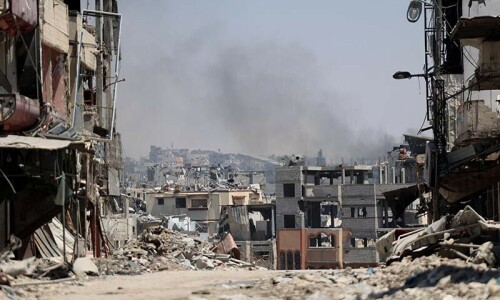
GAZA STRIP: Explosions, air strikes and gunfire rattled northern Gaza on Saturday, the third day of an Israeli military operation that has uprooted tens of thousands of Palestinians and compounded what the UN called “unbearable” living conditions in the territory.
A correspondent reported explosions from the Shujaiya area near Gaza City, and a resident saying bodies were seen on the streets. The armed wings of both Hamas and Islamic Jihad said they were engaged in ongoing fighting with Israeli forces there.
Israel’s military, meanwhile, said its operations were continuing in Shujaiya where fighting “above and below the ground” left a “large number” of militants dead.
A resurgence of fighting in the area comes months after Israel declared the command structure of Hamas militants dismantled in northern Gaza. Last Sunday, Israeli Prime Minister Benjamin Netanyahu said the “intense phase” of the war was winding down after almost nine months, but experts see a potentially prolonged next phase.
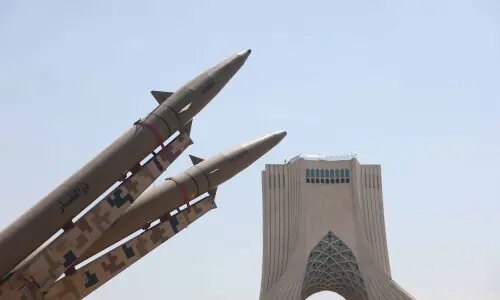
The Gaza war has also led to soaring tensions on Israel’s northern border with Lebanon, leading Iran on Saturday to warn of an “obliterating” war if Israel attacked Lebanon.
Fleeing empty-handed
Mohammed Harara, 30, said he and his family felt they too would become part of that toll. He said they fled their home in Shujaiya with nothing, “due to the bombardment by Israeli planes, tanks and drones”.
“We couldn’t carry anything from the house. We left the food, flour, canned goods, mattresses, and blankets,” Harara said. Israel’s military said it was conducting “targeted raids” backed by air strikes against Hamas in the Shujaiya area. The United Nations humanitarian agency OCHA estimated that “about 60,000 to 80,000 people were displaced” from the area this week.
AFPTV images on Saturday showed men moving belongings on a donkey cart, people being pushed in wheelchairs and children with backpacks passing piles of debris.
“I saw a tank in front of the Shuhada mosque firing” at targets, said Abdelkareem al-Mamluk. “There were martyrs in the street.”
Elsewhere, Gaza’s civil defence agency on Saturday said four bodies were pulled from an apartment after an Israeli strike in the central region. Further south, in the Rafah area, witnesses reported dead and wounded after a new Israeli incursion.
Tarek Qandeel, director of the medical centre in Al-Maghazi, central Gaza, said it was seriously damaged when a neighbouring house was bombed, making it the latest Gaza medical facility affected by the war.
The United Nations, in a report on Friday citing Gaza’s health ministry, said “about 70 per cent of health infrastructure has been destroyed”.
No bathrooms
Separately, a UN spokeswoman, Louise Wateridge, said by video link she had just returned to central Gaza after four weeks outside the territory. “It’s really unbearable,” she said, describing a “significantly deteriorated” situation.
“There’s no water there, there’s no sanitation, there’s no food,” and people are returning to live in “empty shells” of buildings. In the absence of bathrooms, they are “relieving themselves anywhere they can”.
The UN says most of Gaza’s population is displaced, but the fallout from the war has also uprooted people on both sides of the Israel-Lebanon border, where Lebanon’s Hezbollah movement and Israeli forces have engaged in near-daily exchanges of fire.
Such exchanges have escalated this month, alongside bellicose rhetoric.
Israel’s military said plans for a Lebanon offensive had been “approved and validated”, prompting Hezbollah to respond that none of Israel would be spared in a full-blown conflict.
‘Psychological warfare’
In a post on social media, Iran’s mission to the UN in New York said it “deems as psychological warfare” Israeli threats to “attack” Lebanon. But it added such a move would lead to an “obliterating” war that could involve “all resistance fronts”, a reference to Iran-backed groups in the region.
Among those are Yemen’s Houthi rebels, who have for months targeted international shipping in the Red Sea area, saying they are acting in solidarity with Palestinians.
On Friday, the Houthis claimed a “direct hit” on a tanker, but a maritime security agency run by Britain’s Royal Navy reported no damage.
The US Navy has retaliated against Houthi targets after such attacks, and on Friday the US military said it had destroyed seven drones and a control station vehicle in Huthi-controlled areas of Yemen.
Published in Dawn, June 30th, 2024