Israel-Hezbollah tensions drive fears of widening Gaza war



BEIRUT: Fears of a regional war rose on Thursday after Lebanon’s powerful Hezbollah movement said none of Israel would be spared in a full-blown conflict, and Israel said it had approved plans for a Lebanon offensive.
Experts are divided on the prospect of wider war, almost nine months into Israel’s vow to eradicate Hamas, the Palestinian group in the Gaza Strip.
On Wednesday, Israel’s top army spokesman said Hamas, as an ideology, cannot be eliminated. Others, including US Secretary of State Antony Blinken, have also pointed to the difficulty of destroying the group.
In a televised address, Hezbollah chief Hassan Nasrallah said “no place” in Israel would “be spared our rockets” if war began.
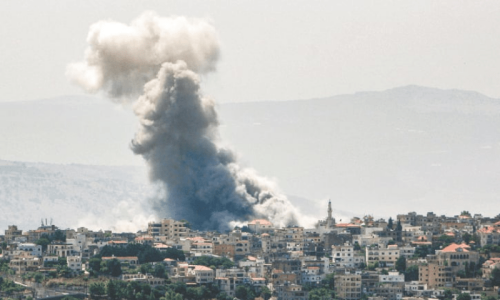
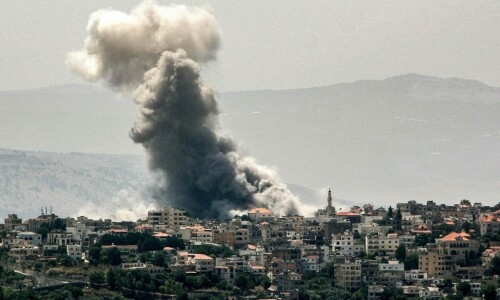
Nasrallah’s group has exchanged near-daily fire with Israel since Hamas’s October 7 attack on southern Israel, but the fire from Hezbollah rockets, Israeli warplanes and other weapons has escalated in the past few weeks.
The Hezbollah chief also threatened the nearby island nation of Cyprus if it opened its airports or bases to Israel “to target Lebanon”.
Cyprus, a European Union member, is home to two British bases, including an airbase, but they are in sovereign British territory and not controlled by the Cypriot government.
Cypriot President Nikos Christodoulides denied his country’s involvement in the war and said it was “part of the solution”. He pointed to its role in a maritime humanitarian corridor to Gaza.
Warplanes from the British airbase in Cyprus have, along with United States forces, carried out reprisal strikes against Yemen’s Houthi rebels who have for months been attacking shipping in nearby waterways.
Hundreds killed
On Wednesday, the US military said its forces destroyed two Houthi sites in Yemen. The Houthis and Hezbollah both say they are acting in response to Israel’s actions in Gaza.
On Tuesday, Israel’s military announced that “operational plans for an offensive in Lebanon were approved and validated”, and Foreign Minister Israel Katz warned of Hezbollah’s destruction in a “total war”. US envoy Amos Hochstein called for “urgent” de-escalation.
On Tuesday, Hezbollah published a more than nine-minute video showing drone footage purportedly taken by the movement over northern Israel, including parts of the city and port of Haifa.
Two former Israeli security officials were split on the prospect of wider conflict. One told AFP there would be an operation in Lebanon “within a few weeks” while another said the government was “more interested in a ceasefire”.
The cross-border violence has killed at least 478 people in Lebanon, according to an AFP tally. Israeli authorities say at least 15 soldiers and 11 civilians have been killed in the country’s north.
South Gaza aid ‘deterioration’
Tens of thousands have been displaced on the Israeli side of the frontier, and the UN’s International Organisation for Migration says more than 95,000 have been uprooted in Lebanon.
In southern Gaza, a United Nations assessment mission found hundreds of thousands of displaced people “suffer from poor access to shelter, health, food, water and sanitation,” a UN report said late Wednesday.
UN deputy spokesman Farhan Haq said there had been “an improvement” in aid reaching northern Gaza “but a drastic deterioration in the south”. US President Joe Biden has called for the implementation of a ceasefire plan he outlined last month.
Hochstein said the plan would ultimately lead to the end of the Gaza conflict, which would in turn quell fighting between Israel and Hezbollah.
On a Middle East tour earlier this month, Washington’s top diplomat, Blinken, similarly said “the best way” to help resolve the Hezbollah-Israel violence was resolution of the Gaza fighting.
Published in Dawn, June 21st, 2024