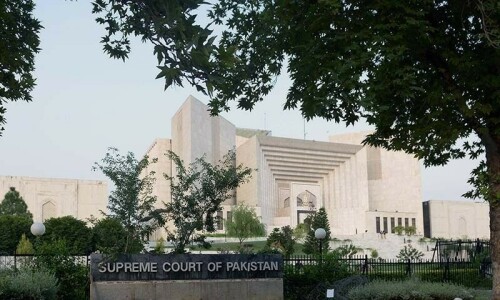
ISLAMABAD: The Karachi Bar Association (KBA) and the Islamabad Bar Association filed two separate petitions on Saturday to become parties in a Supreme Court case concerning alleged interference by intelligence agencies in judicial affairs.
The petitions, moved by senior counsel Salahuddin Ahmed, urged the Supreme Court to order the federal government to devise appropriate mechanisms for effective scrutiny and oversight over the functioning of intelligence agencies to ensure they should not transgress their lawful domain and are duly regulated through requisite legislation.
The petitions come as a six-judge Supreme Court bench, headed by Chief Justice Qazi Faez Isa, will resume the “judicial meddling” suo motu case on April 30 (Tuesday).
Other bench members include Justices Syed Mansoor Ali Shah, Jamal Khan Mandokhail, Athar Minallah, Musarrat Hilali and Naeem Akhtar Afghan. Justice Yahya Afridi has already recused himself from the bench and will no longer participate.
Islamabad, Karachi bar associations file separate pleas before apex court
The Supreme Court has already clubbed a set of 10 petitions and applications seeking its intervention in response to allegations of “intelligence agencies’ meddling in judicial affairs”, which were highlighted following a March 25 letter by six Islamabad High Court (IHC) judges.
Now, the fresh petitions requested the Supreme Court to declare that vesting prerogative to constitute benches and mark cases to the unilateral and unstructured discretion of chief justices of the high courts harms both the external and internal independence of the judiciary and violates Articles 10-A, 175, 192 and 202 of the Constitution.
The petition moved by KBA also asked the Supreme Court to direct the high courts to frame appropriate rules and guidelines on the administrative side detailing how any complaint by judges or staff of the high courts and subordinate courts of external interference in judicial or court-related functions should be reported and how it should be redressed.
As far as the judges and staff of the Supreme Court are concerned, the petition asked the top court to direct the registrar to place proposals for consideration by the full court.
The petition also sought a direction for the high courts to hold full court and ascertain whether any judges of those courts have similar complaints. After ascertaining such information, the high courts should pass orders or directions to safeguard the judiciary’s independence, protect it from future intrusions, and initiate appropriate proceedings against any officers or persons responsible.
The petition highlighted that it was high time that the observations and directions made by the Supreme Court in the Asghar Khan and Faizabad sit-in cases regarding effecting monitoring and regulation of intelligence agencies be implemented in letter and spirit.
It said the intelligence agencies cannot continue to operate in what practically amounts to a legal vacuum and grants them unchecked powers without any effective executive or legislative oversight or accountability.
The petition filed by the IBA asked the Supreme Court to declare that the rules and orders of the respective high courts should be periodically reevaluated by the full court of the respective high court so that all the justices can perform their functions in accordance with Article 194 of the Constitution.
The petition also urged the top court to issue directions, after consultation with all the justices of the Supreme Court, the IHC or any other high courts, regarding the mandatory duties of the justices of the high court to report and have reporting mechanisms in instances where the executive, including its operatives, seek to interfere, pressurise, harass or intimidate the justices of the high court or any of the judges of the subordinate judiciary under the supervision of the respective high courts and a mechanism for institutional response in such matters be devised.
The petition urged the Supreme Court to declare any interference by the executive in the affairs of judicial functions and against the independence of the judiciary illegal and unconstitutional.
Published in Dawn, April 28th, 2024