



 0
0

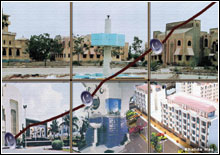 ACUTE shortage of housing coupled with high land prices and ever-soaring cost of building materials continues to be a major social problem. Added to that the rising interest rates on loans for house building and paucity of such loans with banks’ preference for short-term loans.
Meanwhile, the government has raised the loan-equity ratio to 80:20 from 70:30 And the exposure of banks to housing loans has been raised from five to 10 per cent of their net advances and the maximum per party limit has been increased from Rs5 million to Rs10 million.
In spite of such liberal provisions with reasonable safeguards and the financial needs of the housing industry is estimated at Rs64 billion to Rs70 billion, the readily available cash for this purpose is too little.
The 1988 census showed the number of housing units then at 19.3 million. And the shortage since then has risen from 4.3 million a year to six million units.
The annual additional need is 570,000 units, while the annual production of all kinds of housing is 300,000 units leaving a shortfall of 270,000 units annually.
In order to overcome that backlog over a period of 20 years, the overall production of housing units has to rise by 820,000 units annually, preferably by a million units. Unlike the modern states that have an average of five members per house hold, Pakistan’s economic figures are based on 6.5 per cent per family because of the high population growth and large size of families. That was how 19.3 million houses were holding a population of over 135 million in 1988.
Much that has to be done on paper has been done and housing and construction has been declared a priority industry and the government has come up with a National Housing Policy to accelerate house building. And there is also the prime minister’s ‘housing-for-all programme’.
But the priority accorded in policy formulation is lacking in implementation. There are too many hurdles beginning with the provincial governments, the politically powerful land grabbers and the politicians interested in preserving the ‘kutchi abadis’ as their vote bank. And now the soaring price of land add to the complications.
The provincial governments too are not ready to gift lands to federally -sponsored housing schemes, but the Punjab government has taken a lead.
Building material prices from sand, stones and wood to cement and steel have been rising steadily. Two years back, the federal government reduced the excise duty on cement by 25 per cent but the cement manufactures did not pass on that benefit to the house builders. Instead they raised the prices and preferred sending cement to Afghanistan at higher prices. Last week the newspapers reported the cement prices has been raised in a week by Rs6—7 per bag.
Skilled construction workers including carpenters are few and their wages too have been rising fast and they want a large cut in the heavy rise in housing prices..
Over-taxation of the housing inputs including paints, electric wires etc is high. The stamp duty of the provinces, particularly in Sindh, has been very heavy and that has stood in the way of transfer of property. Moderate reduction in stamp duty has now bought some relief.
In such an environment, the Prime Minister’s “Housing forall” programme can’t be a success within a reasonable time unless special steps are taken and the banks are made to increase their financing.
Meanwhile, foreign investors from Saudi Arabia, UAE and other Gulf countries and Malaysia in the Far East want to promote the housing industry for the upper and middle income groups with fixed income.
The House Building Finance Corporation which is opening its branch at Gwadar has established its branches in 90 cities to finance the middle and lower income groups. It has increased the amount of loan its offers and reduced the interest rates and made the terms of lending less rigid.
We need far more lending institutions to help house building for low income groups. While foreign investors are coming to invest in the housing sector or develop it through their organizing skill, locals are investing on upper class housing in UAE, in Dubai in particular. It is not only Pakistanis who are going to Dubai to invest in housing, but also other nationals to speculate in the real estate business there.
As the volume of such investment has been substantial, the central board of revenue in Islamabad has stepped in to investigate their tax credentials in Pakistan and the source of their funds.
Since such Pakistani investors are not ready to furnish the details of that investment, the CBR is seeking support of the UAE government under the avoidance of double taxation agreement between the two countries. But the UAE government is apparently not ready to volunteer such details and prefers to protect the identity of the investors zealously.
The world is moving too fast while Pakistan stays stuck in its old problems stolidly and suffers while its very rich enjoy both at home and abroad.
The government has to take the housing problem more seriously than it has and make its national housing policy come into action with full vigour. And it has to aim at building a million housing units per year for the next 20 years so that every Pakistani will have roof over his head.

























