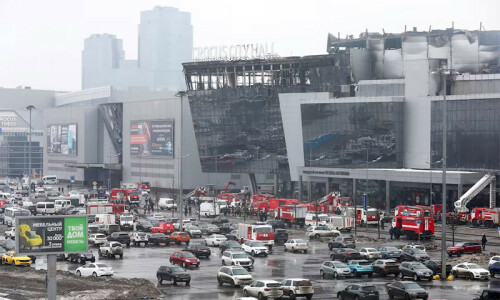
THE monstrous terrorist attack targeting a concert hall near Moscow on Friday night should alert the international community to the threat the self-styled Islamic State’s Khorasan chapter poses to global security.
While the ‘original’ IS may have been largely defeated in the battlefields of Iraq and Syria, IS-K is proving itself to be a ‘worthy’ successor to its parent outfit’s blood-soaked legacy.
Over 140 people were mowed down in the Moscow attack, which IS-K has claimed, while Russian authorities say several suspects, including some of the attackers, have been apprehended. While Russian intelligence agencies claim the perpetrators have links to Ukraine, Kyiv has denied this.
IS-K, believed to be operating out of Afghanistan, has been slowly building its profile. It has staged several attacks in Afghanistan as well as Pakistan. In January, it bombed the commemoration ceremony of Iranian Gen Qassem Soleimani in Kerman, causing a high number of fatalities.
With the Moscow attack, the terrorist group seems to be expanding its geographical scope. Russia had in decades past dealt with religiously inspired militancy, including in Chechnya and Dagestan. In more recent times, Vladimir Putin’s forces intervened to turn the tide in favour of Syrian forces fighting both their political opponents and jihadists.
Moreover, thousands of Russian — Chechens and others — jihadists had fought against Bashar al-Assad’s regime during the Syrian civil war. Now that the Syrian front is largely quiet, these militants, under the IS-K flag, may have decided to take their fight to Russia proper to avenge their defeat.
Just as it took a multinational effort to defeat IS, a similar endeavour will be needed to destroy IS-K before it spreads its deadly wings any further. This will require the international community to closely coordinate with the Afghan Taliban, whom IS-K opposes. Afghanistan, and those states that border it, particularly Pakistan, need to be in the forefront of the fight against the Khorasan faction, as these countries are the most vulnerable to IS-K’s bloody forays. Iran, the Central Asian states, China and Russia should also be on board to contain the regional threat, and neutralise it.
Moreover, the Taliban need to understand that letting militants operate on their soil — including TTP terrorists — will jeopardise the security of their own country, as well as that of the greater region. Counterterrorism assistance should be extended by foreign states to the de facto Afghan regime in the fight against IS-K, TTP and others.
Pakistan has reiterated the need for collective efforts. Also, further investigation is needed to probe Moscow’s claims of state support for IS-K. Needless to say, supporting such bloodthirsty actors would be a folly of monumental proportions.
Some foreign actors made similar mistakes in Syria by financing and arming anti-Assad extremists. Such dubious manoeuvres should not be repeated.
Published in Dawn, March 24th, 2024