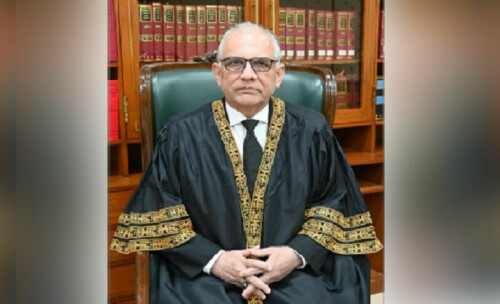
ISLAMABAD: Justice Syed Hasan Azhar Rizvi on Wednesday highlighted apparent flaws in the workings of the Supreme Judicial Council (SJC), particularly in the process of fixing, listing and hearing complaints or references against the superior court judges.
In a dissenting note issued on Wednesday, Justice Rizvi said these issues not only hinder the effective functioning of the council, but also pose a threat to the independence of the judiciary, resulting in the erosion of public confidence in this highest judicial institution.
His note was part of the Feb 19 Supreme Court 4:1 split decision which held that proceedings pending before the SJC against superior court judges on misconduct will not abate in the event of resignation or retirement of a judge. Justice Rizvi was the only dissenting judge.
In the past, Justice Rizvi noted, there had been a tendency to pick and choose specific complaints, and many complaints have abated due to the retirement of the respondent judge.
Besides, the Supreme Judicial Council Procedure of Enquiry 2005 grants unfettered powers to the chief justice of Pakistan (CJP), the SJC chairman, to convene a council’s meeting for discussion and inquiry into the received information.
Given this, the Supreme Judicial Council Procedure of Enquiry 2005 needs to be amended accordingly, but it would be inadvisable and inappropriate to give any specific direction to SJC, Justice Rizvi said.
It is, however, expected that the council will implement clear and transparent procedures for fixing, listing and hearing complaints, preventing undue delays or manipulation.
Justice Rizvi said it transpired from the record that the grievance of the appellants arises from the refusal of SJC to initiate proceedings on a complaint filed against former CJP Saqib Nisar after his retirement.
This is followed by the interpretation of Article 209 as presented by a two-member bench of this court in the impugned judgement, which states that Article 209 does not apply to a person who has retired or resigned from the office of a judge of the Supreme Court or a high court.
The record shows that the present appeals by the federal government and Afiya Sheherbano were not filed within the prescribed period of limitation.
Published in Dawn, March 21st, 2024