AI poses threat to democracy, summit told
Published March 19, 2024
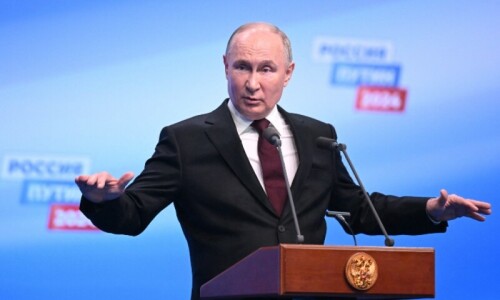
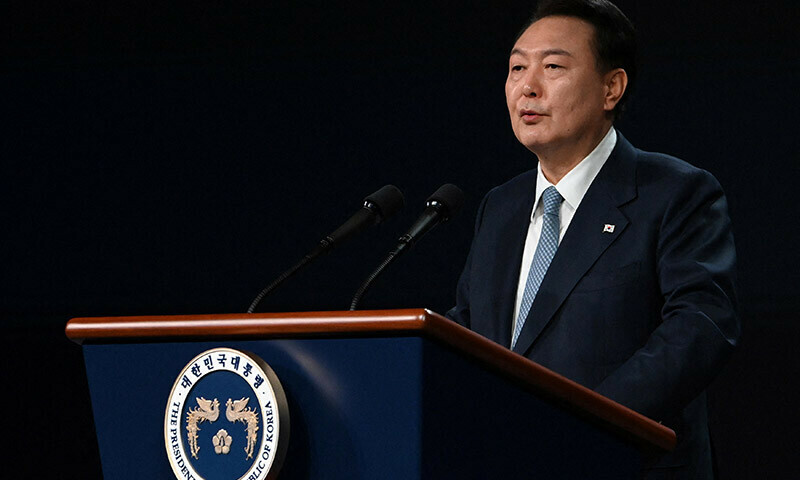
South Korean President Yoon Suk Yeol speaks during an opening ceremony for the 3rd Summit for Democracy in Seoul, South Korea on 18 March 2024 — Reuters
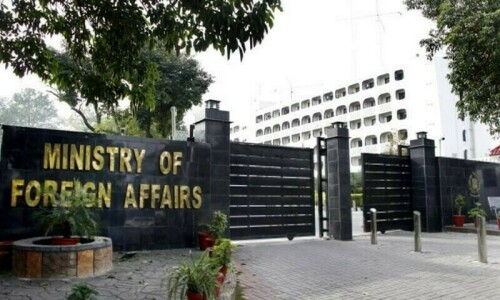
DEMONSTRATORS protest outside South Korea’s foreign ministry against the conflicts in Ukraine and Gaza after US Secretary of State Antony Blinken arrived in Seoul, on Monday.—AFP

SEOUL: South Korean President Yoon Suk Yeol on Monday called fake news and disinformation based on AI and digital technology threats to democracy, as some officials attending a global summit accused Russia and China of conducting malicious propaganda campaigns.

Speaking at the opening of the Summit for Democracy in Seoul, Yoon said countries had a duty to share experiences and wisdom so that artificial intelligence and technology could be employed to promote democracy.

“Fake news and disinformation based on artificial intelligence and digital technology not only violates individual freedom and human rights but also threatens democratic systems,” Yoon said.

South Korea is hosting the third Summit for Democracy conference, an initiative of US President Joe Biden aimed at discussing ways to stop democratic backsliding and erosion of rights and freedoms.

On Monday, China hit back at Seoul for inviting Taiwan Digital Minister Audrey Tang to give a video address.

Though a presenter said Tang was speaking in a private capacity, her participation was not announced ahead of time by either Taiwan or South Korea, which has boosted ties with Washington but also sought to prevent major impact to its deep economic ties with China.

Chinese foreign ministry spokesperson Lin Jian said efforts to “expand the space for Taiwan independence activities under the banner of democracy and human rights” were doomed to fail.

Digital threats to democracy, and how technology can promote democracy and universal human rights, were expected to be the main agenda of the three-day meetings in Seoul, attended by representatives from more than 30 countries, ranging from Costa Rica to the United States and Ghana.

Published in Dawn, March 19th, 2024
Opinion

Geopolitical shift in ME

Geopolitical shift in ME

A prolonged conflict will have far-reaching implications for regional geopolitics, sharpening the divisions among Gulf countries that are directly affected by the tensions.

Editorial

Unyielding stances
Updated 13 May, 2026

Unyielding stances

Every day that passes without clarity on how and when the war will end introduces fresh intensity to the uncertainty roiling global markets and adds to the economic turmoil the world must bear because of it.
Gwadar rising?
13 May, 2026

Gwadar rising?

COULD the Middle East conflict prove to be a boon for the Gwadar port? Islamabad’s push to position Gwadar as a...
Locked in
13 May, 2026

Locked in

THE acquittal of as many as 74 PTI activists by a Peshawar court in a case pertaining to the May 2023 violence is a...
Bannu attack
Updated 12 May, 2026

Bannu attack

The security narrative and strategy of the KP government diverges considerably from the state’s position.
Cotton crisis
12 May, 2026

Cotton crisis

PAKISTAN’S cotton economy is once again facing a crisis that exposes the country’s flawed agricultural and...
Buddhist heritage
12 May, 2026

Buddhist heritage

THE revival of Buddhist chants at the ancient Dharmarajika Stupa in Taxila after nearly 1,500 years is much more ...