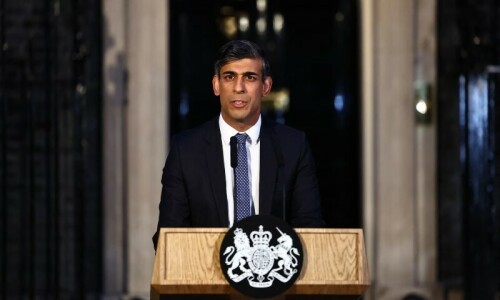
THE British government’s recent decision to redefine extremism has stirred up debate about the motives behind the move, and the greater ramifications it may have for those who disagree with state policy. There are genuine fears that the British decision could prompt other Western states — pandering to populist constituencies — to take similar steps.
Much like the global debate regarding the elusive definition of terrorism, overly broad interpretations of extremism could be used to haul up those critical of the state in the name of making the world safe from extremists. There is reason to be wary as leading members of the UK’s ruling Conservative Party, including the prime minister, have termed pro-Palestine marches in the country ‘extremist’. Some Muslim groups have already been named by British officials as falling under this new definition, and others may be next.
Redefining extremism may well be the first step to clamping down on advocacy for Palestine. Ironically, many Western governments are rattled by the pro-Palestine ‘from the river to the sea’ chant, deeming it extremist, yet fail to see the monstrous, genocidal extremism of the Israeli state.
While states need to act against radicalised actors that preach violence against non-combatants, it must be ensured that national liberation movements, such as the Palestinian struggle, are not tarred as ‘extremist’, and that governments don’t use broad powers to lock up those who criticise the official line. This grand crusade against ‘extremism’ could meet the same fate as the ‘global war on terror’, an endless campaign which, while claiming to fight terrorism, ended up destroying countries such as Afghanistan and Iraq.
The new anti-extremism campaign could disproportionately target Muslims and others in Western societies simply for speaking up for Palestine, or criticising the war-mongering of Western governments. It could also influence right-wing actors, such as India’s BJP, to tighten the screws on their own Muslim populations in the name of fighting ‘extremism’.
Instead of coming up with narrow definitions, the international community should deliberate on what exactly qualifies as hate speech and extremism. Certainly, violence and threats of violence and intimidation against religious groups, sects, or ethno-linguistic communities are unacceptable, and most states already have laws to address these threats. Moreover, antiterrorism legislation has to be accompanied by sufficient legal safeguards so that individuals accused of committing or promoting violence can defend themselves.
Bypassing fundamental rights in the name of defending them is inexcusable. Arguably, ‘extremism’ is an even more subjective term than ‘terrorism’, which is why it is essential that there is maximum global consensus on what constitutes extremism.
If the aim is to stop the demonisation of certain communities, then global consensus should be easy to reach. Otherwise, moves to redefine extremism will remain suspect.
Published in Dawn, March 18th, 2024