THEY may be the undisputed leaders of their respective parties and hold the key to their vote banks, but today, both Nawaz Sharif and Imran Khan have been seriously handicapped in their decision-making by the same hand, as is evident from the ground reality.
Let’s first take the case of Nawaz Sharif, who returned to the country ahead of the February elections to lead his party’s lacklustre campaign. Lacklustre because, commentators say, he was, uncharacteristically, too trusting of the very people who upended his rule in the past.
Here, a moment of introspection is also imperative to acknowledge that many analysts and commentators, including this columnist, were also fooled by the so-called establishment’s ostensible support to the PML-N leader. Many of us put our money on the wrong Sharif!
There can be no denying that supporters of Nawaz Sharif’s main opponent, Imran Khan, turned out in significant enough numbers on polling day to lend a helping hand, unwittingly of course, to those who were wary of letting the older of the two Sharif brothers march back to power.
Will Imran Khan and Nawaz Sharif ever see eye to eye on the need for a genuine democratic transition in the country?
On the other hand, there was never any ambiguity about the establishment’s determination to stop Imran Khan ascending the Islamabad throne, as was clear from his imprisonment and a slew of cases and verdicts against him, his party and supporters, women included. An undisclosed number remains in prison.
It has been argued that the overkill in three rapid-fire judgements against him in cases that are likely to be overturned on appeal triggered many of his voters and made them come out and vote in droves, necessitating last-minute, and rather crude, firefighting.
None of Imran Khan’s detractors have a clue as to how to work the social media to their advantage as the PTI does, and that alone allowed it to stay in contact with its voters. However, even social media domination has its limitations when the adversary has the sort of brutal power they are confronting.
Imran Khan’s imprisonment and relative isolation has left the PTI’s decision-making badly hamstrung. The result is the shambles seen over the question of which was the best political entity to join to maximise its reserved seat share in the assemblies after it was deprived of its right to contest on its own and use its symbol of cricket bat.
Now that the Peshawar High Court, which, in the public perception at least, had appeared to lean towards the PTI, has ruled against the legitimacy of the party’s claim for reserved seats in parliament, many leaders are calling for those in the party hierarchy who announced joining the Sunni Ittehad Council (SIC) to be identified for the ‘mistake’.
With Imran Khan isolated and held incommunicado for long stretches of time and mostly allowed to see his lawyers (who have also been asked to take over key party roles) and not seasoned PTI politicians, his party is often found adrift.
This is the obvious major pitfall of a very strong central leader and no clear leadership hierarchy or party structure. One consequence is that nobody is able to say which leader(s) took the decision to go with the SIC. This, when at least two top lawyer-leaders confirm Imran Khan had decided in favour of Majlis Wahdat-e-Muslimeen or the Maulana Sheerani-led JUI-S.
If Imran Khan’s physical isolation is in place for an extended period of time, similar problems may crop up in decision-making and will have a negative impact on the party and its well-being. There can be no doubt Imran Khan is a larger-than-life leader for his party, but is it prudent that there is no clear second in command or even a ‘committee of elders’ to hold the fort in his absence? Apart from high court debacles, there are also murmurings of discontent over KP cabinet positions and the party nominations for the Senate.
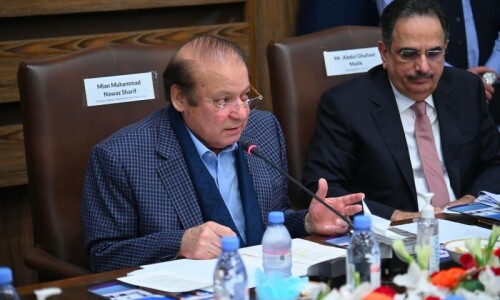
The ground reality facing PML-N leader Nawaz Sharif may be differently constructed, but in effect he has also been blocked from taking key decisions, even when his party is a major coalition partner in government. Anyone who knows how things have worked in the PML-N till now need look no further than the federal cabinet formation.
Agreed that he may have been given the consolation prize of having his daughter placed at the helm in Punjab; however, one of the most important slots in Islamabad hasn’t gone to the man on whom Nawaz Sharif has not been willing to compromise in the past.
Nawaz Sharif has complete and unflinching faith in the financial nous and expertise of Ishaq Dar, as was evident during his own tenure as prime minister, when Dar served as the finance minister, and also under the 16-month PDM coalition, when Nawaz Sharif insisted on the sacking of Miftah Ismail and replacing him with Dar.
It is clear that Nawaz Sharif returned expecting to be the country’s first four-time prime minister and shape the future according to his worldview and vision. Now, he has to live with seeing his first choice as finance minister having been shunted to the Foreign Office. And this amidst the worst economic crisis the country has seen.
As a veteran politician and successful businessman, Mr Sharif knows well how his influence in decision-making will ebb dramatically when his own man isn’t in control of the purse strings. He scuppered Miftah’s Ismail’s planned structural reform because he said it inflicted too much pain on the poor Pakistani.
Now, he’ll witness that pain being forced on the people again and be no more than a silent bystander. Despite their dilemmas rooted in the same source, will Imran Khan and Nawaz Sharif ever see eye to eye on the need for a genuine democratic transition in the country or will they keep playing for tiny gains and no more? This is the question that, probably like you, I’d also like answered.
The writer is a former editor of Dawn.
Published in Dawn, March 17th, 2024