KARACHI: The International Monetary Fund (IMF) has ignored the ‘managed exchange rate’ in Pakistan, providing space for policymakers to stabilise the economy, sources in the financial sector with close contacts in the Ministry of Finance said.
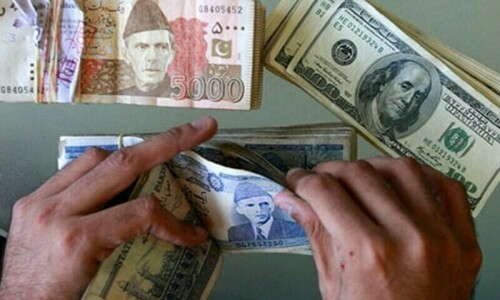
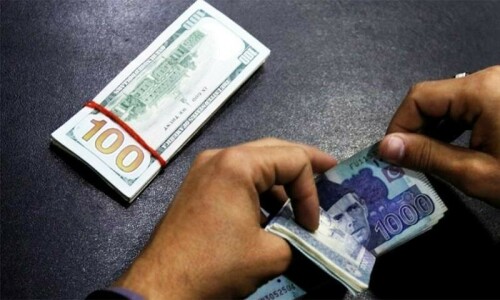
For over two and a half months, the exchange rate has remained almost stable around Rs280, despite the poor performance of the economy and State Bank of Pakistan’s (SBP) low foreign exchange reserves.
Moreover, Pakistan did not follow the IMF’s advice to liberalise imports and allow a 50 per cent increase in the next four months of the current fiscal year.
“During the review of the $3 billion Stand-By Arrangement (SBA), the IMF advised Pakistan to liberalise imports by more than 50pc in the second half of the current fiscal year FY24,” stated a knowledgeable source in the financial sector.
Fund and allies’ support crucial to counter economic challenges
On Friday, the IMF announced its readiness to dispatch a mission for the second review of the SBA after a new cabinet is formed. This announcement was made by the IMF representative, Julie Kozack, during a media briefing.
Pakistan has already received $1.9bn under the SBA, approved by the IMF Executive Board on Jan 11.
This support helped Pakistan to come back from the edge of sovereign default at the end of FY23. China, the UAE, and Saudi Arabia deposited and rolled over loans, providing space for policymakers to improve the situation.
“The situation in the external account has improved but is not sustainable. Pakistan needs continuous support from the IMF and friend countries to avoid default,” said the source, adding that the IMF’s current approach is a clear indication of poor economic health and the necessity for support.
Analysts and researchers believed that the IMF would continue to help Pakistan with another loan package and would not insist on the liberalisation of imports. The central bank’s policy to discourage imports is being followed by the banks, and the drastic cut in imports has helped the current account deficit (CAD) remain thin during the first seven months of the current fiscal year. The CAD during July-Jan FY24 was slightly over $1bn compared to the deficit of $3.8bn in the same period last year.
Pakistan is facing a tough time concerning debt servicing, as the country is required to pay about $1bn due to the maturity of Eurobonds next month.
The new government in Islamabad has not formed the cabinet yet, and a particularly astute finance minister is needed to handle the IMF, which has numerous reservations and conditions before agreeing to a new loan package, potentially around $6bn.
Currency experts have expressed concerns about the high risk regarding the stability of the exchange rate, especially in the wake of declining foreign exchange reserves. In the last couple of weeks, the reserves of the SBP fell twice to stay at $7.9bn.
Faisal Mamsa, CEO of Tresmark, a company that tracks currency movements, explained why the rupee (PKR) remains stable. He noted that while it might not be entirely accurate, it could help in understanding this stability.
Mr Mamsa said one reason for this stability is that imports or outflows are restricted to inflows, maintaining equilibrium and suppressing dollar demand.
He further explained that rupee liquidity was restricted until last week, encouraging banks to engage in sell-buy swaps, resulting in generating dollar liquidity and simultaneously boosting forward premiums. Mr Mamsa added that despite market expectations of a rate cut, the policy rate was maintained to promote rupee demand.
“This is why, for the past several weeks, we have maintained our ‘range-bound’ call on USD/PKR,” he said.
Published in Dawn, March 10th, 2024