Modi visits Indian-occupied Kashmir for first time since special status revoked

Indian Prime Minister Narendra Modi on Thursday said he was working to “win hearts in [occupied] Kashmir”, on his first visit to the disputed region’s main city since its semi-autonomy was cancelled in 2019.
Modi’s government stripped the Muslim-majority territory of its special constitutional status nearly five years ago, splitting the former state into two territories directly ruled from New Delhi.
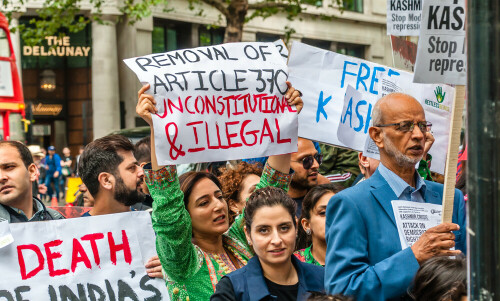
The move, widely welcomed across India, angered many in the densely militarised territory.
“I am working hard to win your hearts, and my attempt to keep winning your hearts will continue,” the Hindu nationalist leader said at a public rally in Srinagar.
“[Occupied] Jammu and Kashmir is not just a region, it is the crown of the country,” Modi said at the rally in a stadium attended by thousands.
Modi took pride in having cancelled the region’s constitutional special status and inherited protections of land and jobs for its permanent residents.
He said the former rules and “dynastic politics” had limited the region’s potential.
Heavy security
“Today, from [occupied] Kashmir I extend my greeting for the coming Ramazan to the entire country,” Modi said, ahead of the holy month, expected to begin in the coming days.
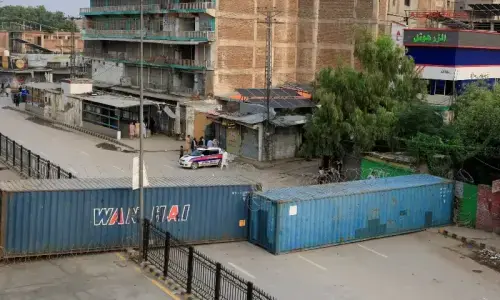
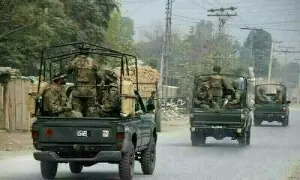
Thousands of armed police and paramilitary forces were deployed, and checkpoints set up across Srinagar.
Modi also remotely inaugurated a slew of development projects and government schemes for boosting agro-economy and tourism in Indian-occupied Kashmir and other parts of India.
The projects included new infrastructure around the revered Muslim shrine of Hazratbal in the city.
The visit comes ahead of India’s national elections due by May, the first since the region lost its autonomy. The last local elections in Indian-occupied Kashmir were held in 2014.
Modi’s government claims New Delhi’s direct rule of Indian-occupied Kashmir brought about a new era of “peace and development”, but critics and many residents say it heralded a drastic curtailment of civil liberties and press freedom.
Security forces on Thursday patrolled the streets, as well as in motorboats along the river that runs through Srinagar.
Most schools in the city were shut for the day, and the authorities had called on government employees to attend the rally.
Omar Abdullah, a former chief minister of Indian-occupied Kashmir, accused the government of organising buses to bring in crowds, alleging that “almost none” would be attending willingly.