• Farmers march on Delhi again to demand higher prices for crops
• Activists believe communication shutdowns aim to quell dissent
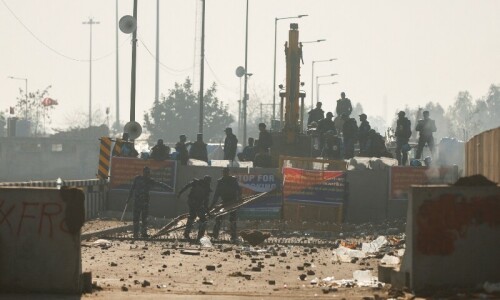
SHAMBHU: They have been beaten with canes, doused in tear gas and blocked by concrete barricades and metal spikes but the thousands of farmers trying to march to India’s capital to demand higher crop prices also face an invisible barrier — digital blackouts.
As their caravan of tractors and trucks moved from the northern state of Punjab towards New Delhi, the farmers found their phones going dead as state authorities imposed temporary internet shutdowns.
It is not the first time authorities have cut the internet — India imposed the highest number of internet shutdowns in the world in 2022 — and campaigners fear more digital crackdowns ahead of elections expected by May.
Farm union leaders are seeking guarantees, backed by law, of more state support or a minimum purchase price for crops.
Since Feb 12, Haryana state authorities have cut access to mobile internet services at regular intervals and for several days at a time. They said they did so to “stop the spread of misinformation and rumours” and to prevent the mobilisation of “mobs of agitators and demonstrators”, according to local media.
The farmers, many of whom are members of the Sikh religious minority from Punjab, say the shutdowns made it hard to get medical help for the injured and to source food. It also cut them off from their leaders, making coordination difficult.
“We’re already far away from home and the communication blackout adds to our miseries,” he said.
Neither the chief minister’s office in Haryana nor the state’s telecoms ministry responded to requests for comment.
Campaigners have accused the Hindu nationalist BJP government led by Prime Minister Narendra Modi of repeatedly using internet shutdowns to stifle opposition.
“The alarming trend of internet shutdowns coupled with widespread online censorship is a grim reflection of digital authoritarianism, particularly in the lead-up to elections,” said Gayatri Malhotra of the digital rights organization, Internet Freedom Foundation.
No signal
India frequently uses internet shutdowns to control protests including in occupied Kashmir and northeastern Manipur state where dozens have died in ethnic clashes since last year.
Mobile access has also often been cut during elections and examinations and these shutdowns were often imposed for indefinite periods and without the publication of shutdown orders, in violation of a 2020 judgement by the nation’s top court.
The state of Haryana ranks fourth in the country for the highest number of internet shutdowns, following Jammu and Kashmir, Rajasthan, and Manipur, according to Delhi-based advocacy group Software Freedom Law Center.
Although the farmers’ protest is confined to Punjab for now, their complaints of falling incomes resonate more widely, highlighting a perception in India’s huge rural hinterland that Modi has done too little to support the farming community and raise living standards.
Over 40 per cent of India’s 1.4 billion people are dependent on agriculture and many say they have suffered economically under Modi.
‘State of darkness’
Hardeep Singh, for example, grows wheat and rice on his four-acre farm, but like many he said poor returns on investments, including pesticides and farm equipment, made it increasingly difficult to make ends meet without guaranteed prices for his produce.
While pollsters say Modi will almost certainly win a rare third term in office, the discontent of farmers will be a headache for years to come.
The federal agriculture ministry did not immediately respond to requests for comment about the protesters’ demands.
Many farmers also said signal jammers were being used in the area, preventing them from contacting people in their villages to ask for food supplies.
Published in Dawn, March 5th, 2024