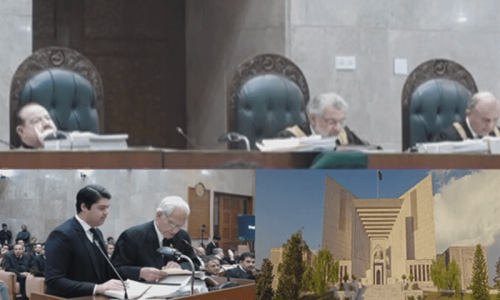
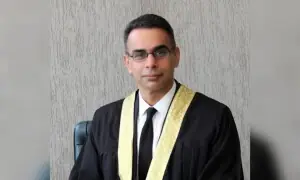
ISLAMABAD: Chief Justice of Pakistan (CJP) Qazi Faez Isa on Tuesday wondered whether revisiting the controversial death sentence awarded to former premier Zulfikar Ali Bhutto offers an opportunity to vindicate judiciary and the armed forces.
“There must be new beginnings at some stage in our very chequered history, since we are perpetually living in the past but not looking at the future,” Justice Isa observed, also explaining martial laws were not imposed by the institution of the armed forces, but individuals.
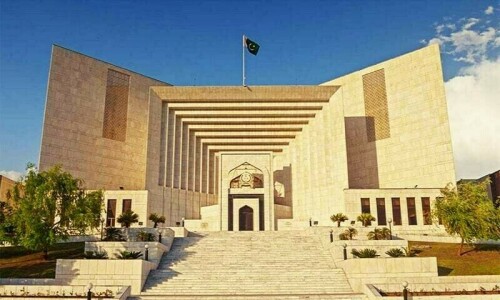
Headed by CJP Isa, a nine-judge SC bench had taken up the reference filed on behalf of then president Asif Ali Zardari on April 2, 2011, to seek an opinion on revisiting the death sentence awarded to Mr Bhutto under the SC advisory jurisdiction.
In a split verdict by four to three, a seven-judge bench had upheld a Lahore High Court verdict of awarding death penalty to the PPP founder during the regime of Gen Ziaul Haq, two years after he had overthrown the PPP government.
Wonders if revisiting Bhutto reference can vindicate judiciary and armed forces
“I find a major problem in the verdict the way it was conducted,” the CJP remarked.
He also wondered if revisiting the case would enhance the reputation of the armed forces and “heal the wounds” of the nation.
Should the courts stay away from this matter, considering this to be the political domain, or adopt an “innovative” approach by being cautious of not treating it as a review, the chief justice noted. Opening a very narrow door could help ensure that the scope is not enhanced allowing review of every other case, he remarked.
Senior counsel Makhdoom Ali Khan, in his capacity as an amicius curiae, said this was a matter of public interest and squarely within the domain of the judiciary, as it relates to public confidence in the administration of justice.
Justice Syed Mansoor Ali Shah noted the only grounds for taking up the presidential reference was that the judges who decided the matter did not act independently, rather “were dictated”, but the only evidence was an interview of former chief justice Dr Nasim Hassan Shah.
“Where is the material to show the judges who decided the Bhutto murder appeal were under pressure?” he asked. Only saying that there was a martial law would be like proposing that all the cases decided during military regimes be declared null and void, he remarked. “It is a major policy decision we have to take,” Justice Shah pointed out.
The counsel, however, said Gen Zia’s interest to have a particular outcome of this case was a well-established fact and part of history books and lend strength to a reasonable apprehension that due process of law was not followed in this case, the counsel argued.
At this, Justice Shah recalled one of the amici, Prof Yasir Qureshi from Oxford University, in his written submission to the court highlighted that several countries were finding ways to undo past injustices, including those committed during the military regimes, by establishing a Truth Commission. He cited the example of Brazil, where executive and legislative pardons were granted.
Justice Musarrat Hilali questioned what remedy Bilawal Bhutto-Zardari and Zulfikar Bhutto junior were going to get if this reference was decided in their favour. She wondered if they would ask for Qisas (blood money).
At this point, a seemingly disturbed PPP chairman stood up from his chair to consult with senior counsel Farooq H. Naek.
Makhdoom Ali Khan, however, suggested to the court that nobody sought any compensation, as the only remedy was reputation and public trust in the justice system.
The CJP said the specific question was if this verdict was a good case to follow.
Justice Jamal Khan Mandokhel observed this could be an opportunity to put an end to interference in court matters from outside. He asked if the court could render an opinion to the president to take this matter back to parliament. The hearing will now resume next Monday.
Published in Dawn, February 21st, 2024