Courts may revisit verdicts if injustice proven, CJP observes in Bhutto case

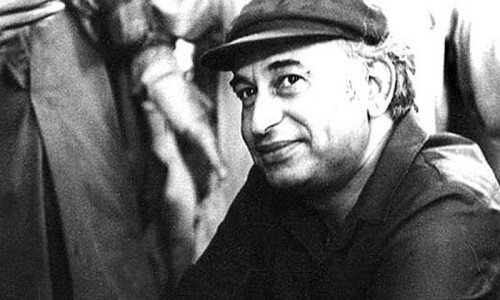
ISLAMABAD: Chief Justice of Pakistan (CJP) Qazi Faez Isa observed on Monday that by hearing the long-pending presidential reference — seeking to revisit the 1979 controversial death sentence awarded to former prime minister Zulfikar Ali Bhutto (ZAB) — the Supreme Court is concerned with the repute of the person, posterity, history, and determining whether such an exercise sets a good precedence for future courts.
CJP, heading the nine-judge Supreme Court bench addressing the reference, explained that the court could revisit its earlier judgements if it is established that a great miscarriage of justice occurred due to the departure from Constitution or political elements in the prosecution.
But to do so, it has to establish the requirements of Article 4 of the Constitution, which ensures that the right of individuals should be dealt with in accordance with the law, CJP said.
When Article 4 cannot be suspended even if emergency was proclaimed or the Constitution was abrogated or put in abeyance, why a person should be prevented from approaching the Supreme Court on the grounds that the requirements of Article 4 were ignored.
Bilawal seeks timely decision, sees chance to rectify history
“Why the court should not revisit all the cases where such departures were made,” CJP questioned.
Justice Syed Mansoor Ali Shah questioned if the court could revisit the judgement by relying on an interview of former CJP Dr Naseem Hasan Shah by journalist Iftikhar Ahmed, taking it at face value. In the interview, Dr Shah claimed that the conviction against Mr Bhutto was the result of pressure.
Justice Shah further questioned whether the court should not conduct a proper inquiry to conclude that injustice was done, especially when other members of the bench, that handed down the same conviction, have not come forward. He noted that it was only one judge who had given the interview.
Senior counsel Makhdoom Ali Khan, appointed amicus curiae by the court, said the present matter was a unique case in the common law jurisdiction where a judge, who was part of the narrowest majority of the bench, gave an interview much after his retirement.
The court postponed further hearing on the reference after the general elections.
Timely decision in ZAB case sought
In a relevant development, PPP Chairman Bilawal Bhutto-Zardari expressed his desire for the decision to be announced before the polls.
In a news conference outside the Supreme Court building after the hearing, Mr Bhutto-Zardari said, “We demanded from the incumbent chief justice that the case must be concluded after the elections and not left on the back burner, as happened in the past when former CJ Iftikhar Chaudhry started the case and after two or three hearings, he forgot about it.”
The PPP chief stated that the judiciary has an opportunity to rectify history.
“The way this case [ZAB’s case] was decided, a precedent was set, and such injustice was repeated time and again. Today we have a chance to set right the history and close the doors of injustice forever.”
Taking a different stance from his previous speeches, where he aggressively criticised PML-N supremo Nawaz Sharif, Mr Bhutto-Zardari urged both PML-N and PTI to learn from their past mistakes to brighten the future for coming generations.
Mr Bhutto-Zardari expressed firm confidence that the next general elections would be held on schedule on Feb 8, as assured by CJP Isa.
Later, US Ambassador, Donald Blome, called on Mr Bhutto-Zardari at Zardari House.
According to the PPP central secretariat, both Mr Bhutto-Zardari and the US ambassador discussed the promotion of bilateral relations. They also exchanged views on ways to increase trade. PPP leader Farhatullah Babar and former Sindh CM Murad Ali Shah were also present during the meeting.
Published in Dawn, January 9th, 2024