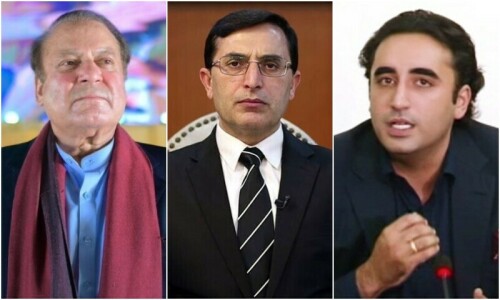
IT appears that a coalition government is in the offing, as no single party has enough seats to form a government.
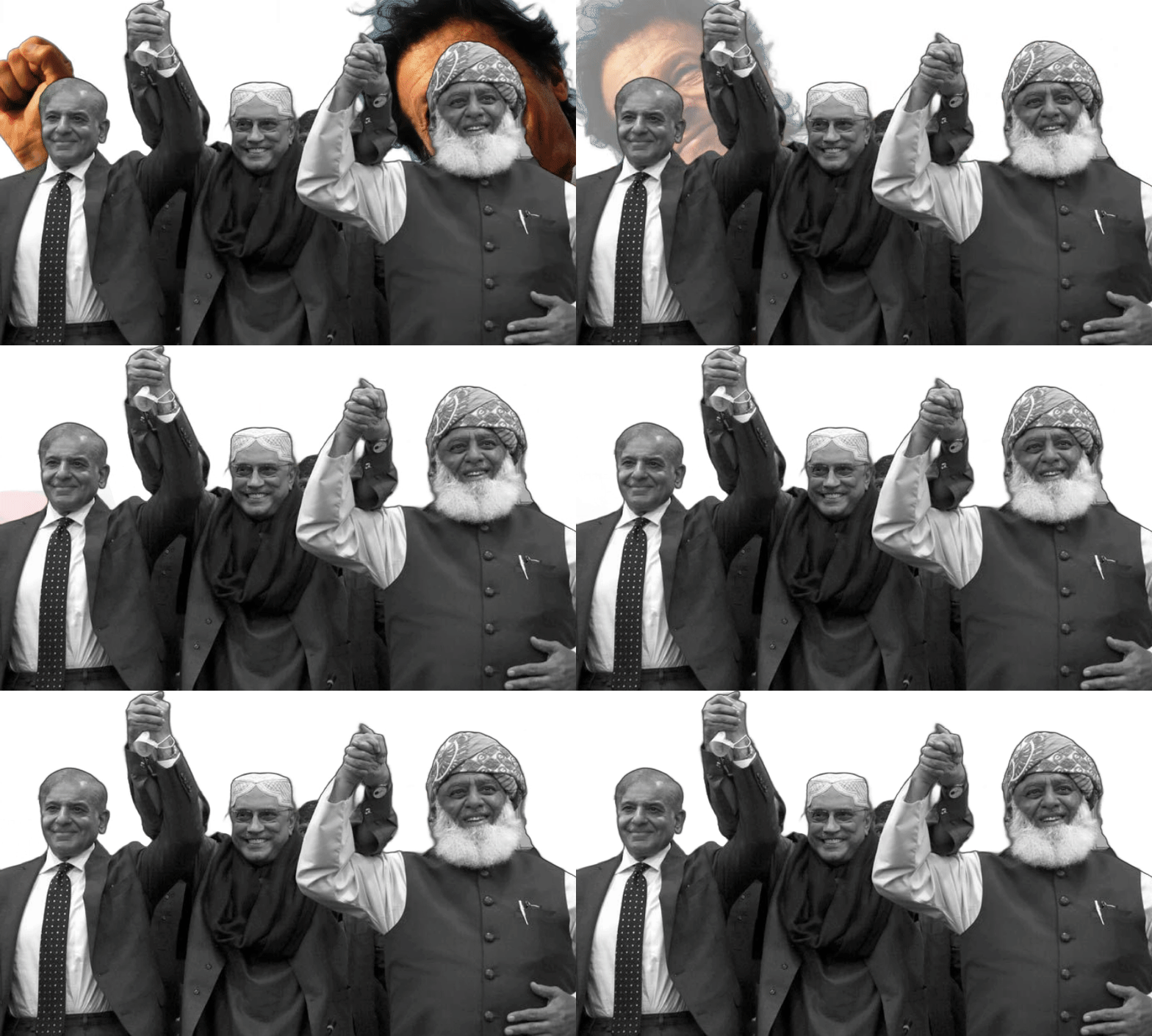
After his ‘victory speech’ some days ago, PML-N supremo Nawaz Sharif said his was the single largest party, and called on other political leaders to initiate discussions and negotiate a way forward. Soon after, there were reports that PPP’s Asif Ali Zardari and PML-N’s Shehbaz Sharif held a meeting, an indication that the two leaders, despite their differences in recent months, are attempting to chart a way forward.
Of course, the role of parties such as MQM-P and other smaller parties, is key as they too will lend support to reach the magic number of seats. The PML-N is optimistic that two dozen or more independents will join their ranks, and is banking on its relationship with different parties to show a victorious front.
As the numbers game plays out, the country once again finds itself in a familiar place — one that is steeped in political uncertainty. In recent months, the PPP and PML-N have had an acrimonious relationship. The PML-N is annoyed that PPP distanced itself from the PDM government’s decisions, and that it was left to face the brunt of the public’s wrath over increasing inflation. Its key members also do not trust Mr Zardari.
Similarly, the PPP has been vocal in its criticism of the N-League, with its chairman Bilawal Bhutto-Zardari taking potshots at Mr Nawaz Sharif during his campaign, and even telling this newspaper in an interview that he was “disappointed” in the former prime minister.
With these misgivings, how will this motley crew sit together in parliament? Whose agenda will take priority? And how will they bring the stability, reforms and leadership the country so badly needs? More importantly, did the public really turn up in large numbers to vote to be ruled by PDM 2.0?
As the wheeling and dealing proceeds, two things are clear: one, that however the PML-N cobbles this coalition together, its ‘victory’ will be more bitter than sweet. Without the outcome it had hoped for, it is now left to perform that uneasy dance of give and take for political survival. This is certainly not the fantasy Mr Sharif harboured when he returned to Pakistan after four years abroad.
The second is that such a government is always vulnerable to outside forces. As we saw previously, the PTI-led coalition government was held together by an external glue, and its days were numbered when that glue did not stick. Forming such a post-election alliance is not unique to Pakistan, as other countries witness similar events and end up having weak governments. But in our case, the vulnerability to external forces further complicates an already fragile democratic process.
Published in Dawn, February 11th, 2024